Nature
 PUBLISHED
 1
1


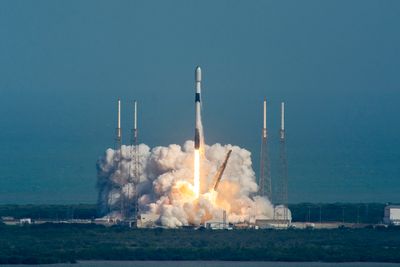


In less than a decade, the number of satellites has more than doubled. There are over 18,000 satellites in orbit at the moment, more than half belonging to megaconstellations, first and foremost SpaceX’s Starlink. The danger of such a high number of objects in space is well known. A new study now looks at what the impact of so many launches has on the upper atmosphere.
Conservative estimates made by the study's authors suggest that megaconstellation launches will account for 42 percent of the total climate impact of the space sector by 2029, with the increase in rocket launches and discarded rocket bodies and satellites burning back to Earth generating soot (black carbon) that lingers in the upper atmosphere.
“The intention was to really use a model that enables us to quantify the potential climate impact and ozone depletion that results from satellite mega-constellation missions that we project out to 2029,” project lead Professor Eloise Marais, from University College London, told IFLScience.
“The black carbon is very effective at absorbing incoming sunlight, warming the surrounding atmosphere but having a slight cooling effect on the air that surrounds us. What we find is that there's a climate effect that's a little bit like geoengineering.”
Our estimates are quite conservative and quite modest in comparison to what's actually happened.
Professor Eloise Marais
We might naively wonder if this could be a blessing in disguise, since it produces a cooling effect on the lower layer of the atmosphere – but black carbon in the upper atmosphere is not a friend. It reduces sunlight reaching the ground across the spectrum, affecting plants' ability to photosynthesize and consequently, crop yields. There are also risks related to the disruption of precipitation and other atmospheric cycles.
Still, the study shows that things could be worse. At least these launches and debris falling back down do not seem to affect the ozone layer much at this time.
“The other effect, the ozone depletion, we found to be quite small because the kinds of rockets that are being used to launch megaconstellations are not producing the kinds of pollutants that tend to be very good at depleting ozone,” said Professor Marais.
The space industry, despite its potential, remains small compared to other sources of pollution. On the other hand, the location of this pollution is in a region that makes it longer lasting and produces a dramatically larger effect.
“Something that I think is key is that both effects are quite small in comparison to industrial pollution that we're familiar with: power plants, ships, cars, and so on,” Professor Marais told IFLScience.
“But if we look at it on a sort of per-pollutant basis, the size of the effect is actually 540 times more than pollution that's produced by industrial sources because the pollutants stay in the atmosphere for so much longer, higher up.”
The modeling is based on launches between 2020 and 2022, a moment where the activity in space increased but had not reached the level we see in the here and now. Rocket launches last year surpassed the model predictions, so the work is underestimating what's happening right now. With Elon Musk's plan to send 1 million satellites into orbit, this might become an extreme underestimation.
“Our estimates are quite conservative and quite modest in comparison to what's actually happened,” said Professor Marais. “This is always going to be an issue. We're trying to project what's happening in the future for an industry that just has so much unpredictability.”
Concern about the type of rocket fuel used by new and different megaconstellation launchers means that the limited impact on the ozone might also change from this modeling.
“The size of the effects is so much smaller than industrial pollution. But this puts us in an excellent position to act now before it grows so large that it becomes a big enough environmental problem that it is hard to repair the damage,” Professor Marais concluded.
The study published in the journal Earth’s Future.