Space and Physics
 PUBLISHED


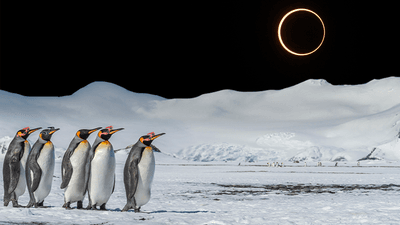


Forget Valentine’s or Mardi Gras (or the launch of Artemis II, for now *cries*). There’s something much more exciting happening this month: the first solar eclipse of 2026, and it’s happening in just a matter of days.
The exact date for this spectacular solar event is February 17, and even better, it’s a so-called “ring of fire” eclipse. But where exactly is it happening? What does “ring of fire” even mean? And what actually is a solar eclipse? Here’s everything you need to know.
What is a solar eclipse?
Solar eclipse is the term for when the Sun, Moon, and Earth line up. The Moon is the piggy in the middle in this scenario, and when it passes between the other two, it temporarily casts a shadow on the Earth and blocks our view of the Sun.
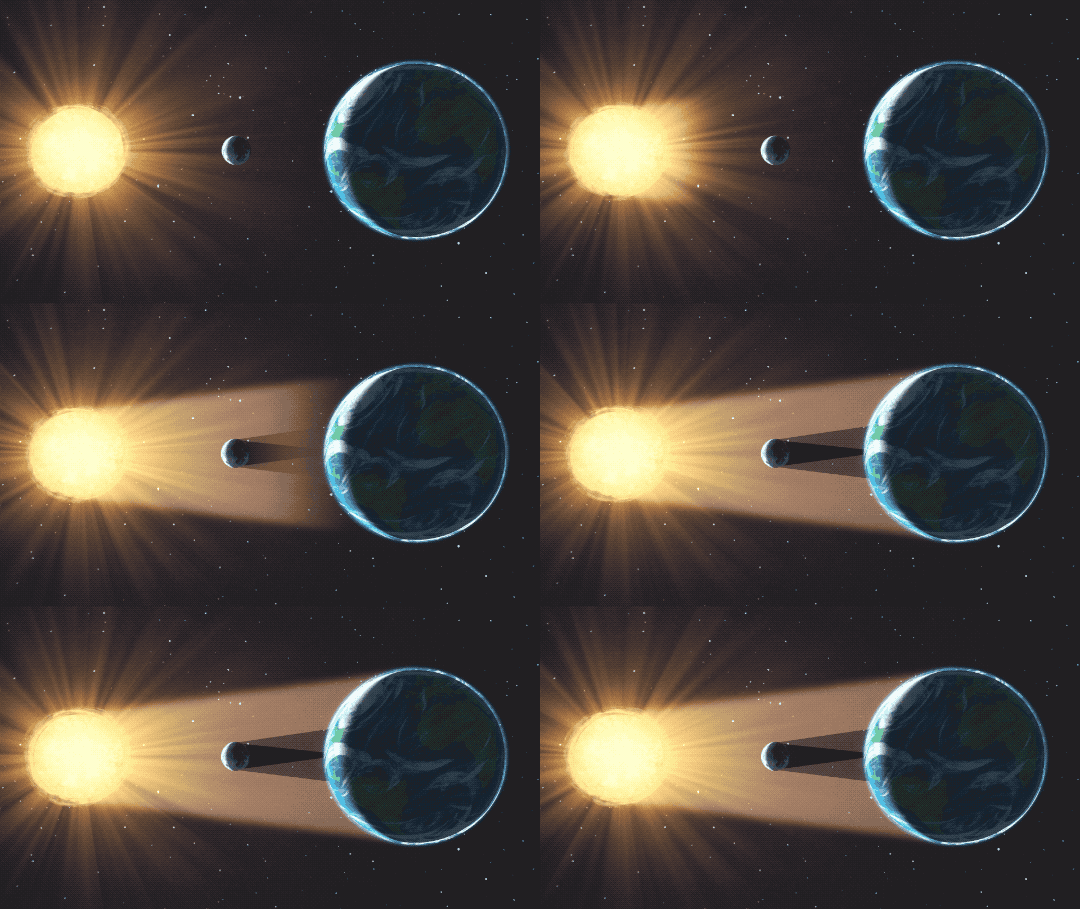
There are different types of solar eclipse, too: total, annular, partial, and hybrid. “Ring of fire” is just another name for an annular solar eclipse, and it’s a very appropriate name too.
No, not because Johnny Cash starts playing in the sky when it happens. During such an eclipse, the Moon is at or close to its farthest point from Earth (apogee). As a result, when it passes in between the Sun and Earth, it doesn’t completely cover the Sun as we see it, leaving a bright ring of light surrounding it.
When and where to see the eclipse
According to TimeAndDate, February 17’s annular solar eclipse is set to begin at 9:56 am UTC, reach annularity (when the Moon is slap bang in front of the Sun) at 12:12 pm UTC, and conclude at 2:27 pm UTC.
But, if you were hoping to have the privilege of seeing the year’s first solar eclipse in all its fiery glory, then I’m afraid we’re going to have to disappoint. Annularity will only be visible from Antarctica. Unless you are a penguin (groundbreaking scientific news if so) or a South Pole researcher, you’re out of luck.
Some parts of the world will be able to see a partial view of the eclipse, though this is limited to a chunk of southern Africa and the tip of South America. Still, there are an estimated 176,000,000 people (and many, many penguins) who’ll be able to see any part of the eclipse, which is no small amount.
And hey, if you’re sad about missing out, fret not – there are plenty more eclipse-based delights to come over the next couple of years. When the opportunity does arise, remember that it’s never safe to look directly at the Sun without wearing eye protection specifically designed for doing so. If you want to find out more about how to safely view a solar eclipse, check out our handy guide here.