Space and Physics
 PUBLISHED
 1
1



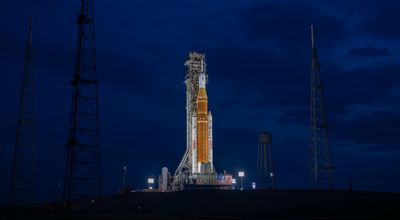


On the evening of Monday, February 2, NASA conducted the wet rehearsal for the Artemis II rocket and spacecraft. The Space Launch System, the space agency’s biggest rocket ever, and the Orion spacecraft were fueled up and sealed up, as if they were about to be launched. The goal was to make sure everything was in tiptop condition or to find any faults. Unfortunately, some issues arose, and NASA has made the decision to postpone the launch.
The earliest Artemis II could have launched would have been this Sunday, February 8. Now, the launch will happen in March. The launch window will be open from March 6 to 11, which means that NASA will likely target February 28 or March 1 for its next wet rehearsal.
“With March as the potential launch window, teams will fully review data from the test, mitigate each issue, and return to testing ahead of setting an official target launch date,” NASA said in a statement.
“Crew safety will remain the highest priority, ensuring NASA astronauts Reid Wiseman, Victor Glover, and Christina Koch, and CSA (Canadian Space Agency) astronaut Jeremy Hansen, return home at the end of their mission.”
During the fueling up of SLS, the team had to spend several hours fixing a liquid hydrogen leak, which delayed the final terminal countdown. In the end, the team successfully filled the tanks, and NASA was able to rehearse the last 10 minutes before launch. The plan was to rehearse this portion of the countdown multiple times.
The clock was supposed to go all the way down to 1 minute and 30 seconds to launch (T-1 minute 30 seconds), where it would have stopped for up to 3 minutes. In the actual launch, if the pause is less than 3 minutes, then the countdown can continue. Otherwise, it goes back to 10 minutes. Unfortunately, the countdown was stopped at 5 minutes when a spike in the liquid hydrogen leak rate appeared.
This was not the only issue. The Orion spacecraft had a valve (connected to the hatch pressurization) replaced, and during the test, it became apparent that it needed retorquing. There were also issues with cameras due to the cold weather, and some audio communications experienced dropouts – all issues that will have to be streamlined before the actual launch next month.
If the March launch window is also not good, the launch will shift to April. The opportunities that month are April 1, 3, 4, 5, and 6. Basically, they need the Moon to be in the right position. This will allow the astronauts to see areas of the Far Side that no human has seen before, as well as breaking other records such as distance of human travel into space and speed of human space travel.