Space and Physics
 PUBLISHED



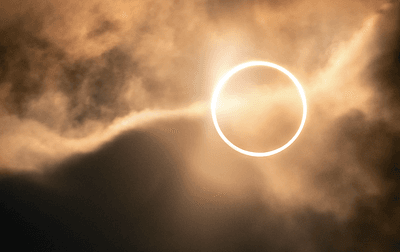


The first solar eclipse of 2026 is less than a month away, and it's set to treat observers to a “ring of fire” spectacle.
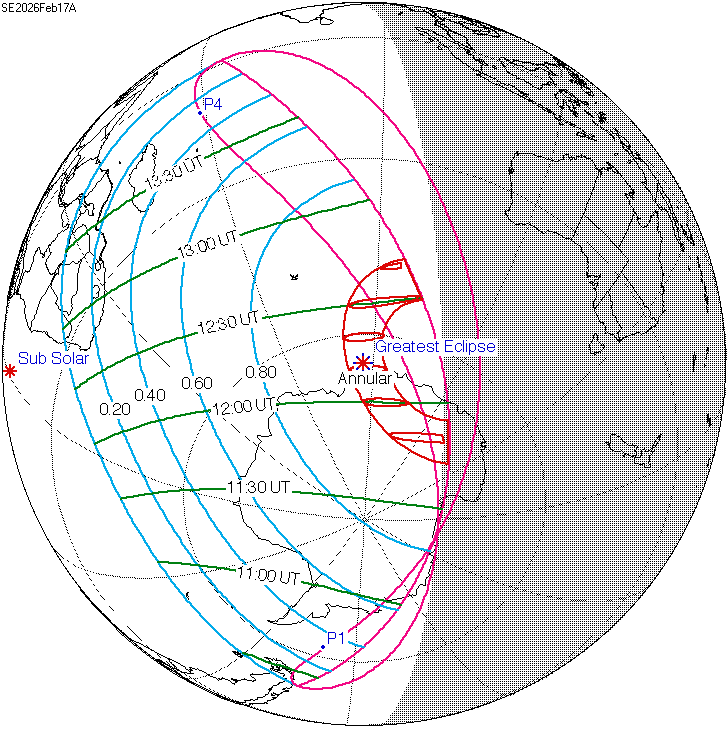
On February 17, 2026, at 09:56 am UTC, the Moon will pass directly between the Sun and Earth, per NASA and Time & Date. At its greatest extent, the Moon will obscure up to 92 percent of the Sun, and the ring will persist for up to 2 minutes and 19 seconds.
Technically known as an annular solar eclipse, this event occurs when the Moon is near its farthest point from Earth. Because it appears slightly smaller in the sky, it won't quite cover the Sun's entire disk. Instead, the Sun will appear as a brilliant halo of light surrounding the Moon's dark silhouette, hence the nickname “ring of fire”.
However, there is one catch: barely anybody will get to see it. The annular solar eclipse will only be visible in a remote part of Antarctica, while a glimpse of a partial eclipse will be visible from southern Africa and the southernmost parts of South America. So, unless you are a researcher stationed at the South Pole or a penguin, you likely won't be able to witness the full event in person.
If you aren't able to charter a flight to the South Pole, don't worry. The February 2026 event is merely the opening act for a mini-golden age of eclipses. After years of relative quiet, the next three years will feature a rapid-fire succession of solar eclipses:
- August 12, 2026 (Total): The first total eclipse in Europe since 1999, passing over Iceland and Spain.
- February 6, 2027 (Annular): Crossing South America and Africa.
- August 2, 2027 (Total): The "Eclipse of the Century", visible over Spain, North Africa and Saudi Arabia.
- January 26, 2028 (Annular): Visible from the Galapagos, Brazil, and Spain.
- July 22, 2028 (Total): Crossing the Australian continent.
That total solar eclipse on August 2, 2027, will definitely be one to watch out for. Dubbed the "Eclipse of the Century", totality will last for over 6 minutes in places, making it the longest of the 21st century. Its path of totality will be roughly 258 kilometers (160 miles) wide across parts of Africa, Europe, and Asia, meaning billions of people will experience at least a partial eclipse. For those seeking the ultimate view, the sweet spot will be near Luxor in Egypt, home to all kinds of ancient archaeological wonders.
Granted, the US and Canada aren’t catching much of the show. However, after experiencing the Great North American Eclipse in April 2024, it's hardly fair to complain.