Space and Physics
 PUBLISHED



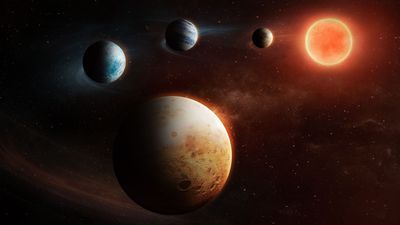


We know that our Solar System is not the blueprint for all planetary systems out there. There are gas giant planets orbiting closer to their stars than Mercury, and rocky worlds much larger than Earth. Still, we had assumed that in multiplanetary systems, the rocky worlds form closer to the star where their ice and gasous atmospheres have been pushed away, and the gas worlds form in the outskirts. Too bad that scientists have now found a system that breaks that pretty important expectation.
The star in question, LHS 1903, is a cool and faint red dwarf. It has four planets; so far, so good. The innermost LHS 1903 b is a rocky world, a super-Earth with a radius 40 percent larger than our planet. It's a lot hotter. Planets LHS 1903 c and LHS 1903 d are much bigger, classified as sub-Neptunes world, and the estimated density is consistent with being gas planets. The problem is the outermost planet, LHS 1903 e.
This world is also pretty large, with a radius about 73 percent larger than Earth’s, but density estimates suggest that LHS 1903 e is rocky. That’s the puzzle. This system appears to have two gas planets sandwiched between rocky worlds, and we didn’t think it was possible.
“This strange disorder makes it a unique inside-out system,” first author Dr Thomas Wilson, Assistant Professor at the University of Warwick, said in a statement seen by IFLScience. “Rocky planets don’t usually form far away from their home star, on the outside of the gaseous worlds.”
The unique system was studied in detail using CHaracterising ExOPlanet Satellite (CHEOPS). CHEOPS is a mission by the European Space Agency (ESA) to work out the size and properties of planets around nearby stars. In this specific case, it has stumbled upon something that could upend our planetary formation models.
“Much about how planets form and evolve is still a mystery. Finding clues like this one for solving this puzzle is precisely what CHEOPS set out to do,” Maximilian Günther, Cheops project scientist at ESA, explained.
“Historically, our planet formation theories are based on what we see and know about our Solar System. As we are seeing more and more different exoplanet systems, we are starting to revisit these theories,” Isabel Rebollido, a Research Fellow at ESA, added.
So how could this system have formed? The researchers suggest that the planet did not form all at the same time, but one after the other, starting from the innermost and going outwards. Each planet accumulated what was available around itself, but by the time LHS 1903 e was forming, the building blocks were a bit depleted.
“By the time this final outer planet formed, the system may have already run out of gas, which is considered vital for planet formation. Yet here is a small, rocky world, defying expectations. It seems that we have found the first evidence for a planet that formed in a gas-depleted environment,” Dr Wilson summarized.
If there is one system like this out there, others will exist. So, the hunt is on.
The study is published in the journal Science.