Space and Physics
 PUBLISHED


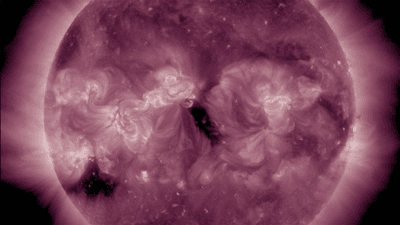


A recent solar storm that hit Earth turns out to have been so powerful it stopped GPS from functioning properly.
In regions of the USA that are usually unaffected by such storms, some positions reported by GPS were incorrect by over 10 meters (30 feet). Whilst that might not sound like much, it is more than enough to cause severe disruption to critical infrastructure.
Whilst most of us get to enjoy solar storms for the gorgeous aurorae they produce in our atmosphere, they are not entirely risk-free, posing particularly tricky problems for satellites. As well as pushing them towards the Earth, it can interfere with GPS communication with various devices on our planet.
How does GPS work?
Despite requiring knowledge of relativity and having objects orbiting us constantly in space, GPS is actually a fairly simple concept to get your head around. Contrary to popular belief that your GPS is pinging the satellites, the signals are only one way.
Around 20,200 kilometers (12,550 miles) above Earth is a constellation of satellites arranged so that, wherever you are on the planet, you should be able to see at least four of them. Each satellite carries several very precise atomic clocks, and continuously broadcasts both its position and the exact time at which its signal was sent.
The locating is done by the receiver – whether that's your sat nav, your phone, or a tracker strapped to a pack of wolves – using some good old-fashioned mathematics, with a little relativity thrown in because apparently ordinary mathematics wasn't complicated enough.
Imagine, for a moment, that you could only receive a signal from one GPS satellite. You know the speed of light, and, if we rather presumptuously assume that your clock is perfectly synchronized with the satellite, you can work out how long the signal took to reach you.
Since you also know exactly where the satellite was when it sent the signal, you can work out a rough location for yourself. More specifically, you can draw a giant circle around the satellite representing every possible location from which the signal could have traveled that particular distance. Your elevation complicates things slightly, but let's not ruin this with unnecessary dimensions. All you know is that you must be somewhere on that circle.
This is, naturally, not terribly useful. You have successfully established that you are somewhere on a gigantic circle surrounding a satellite, which is probably not going to help you find the nearest Applebee's.
Fortunately, your sat nav can see several satellites at once. Get the same information from a second satellite and you can draw another circle. The two circles will intersect at two points, meaning you have narrowed your location down considerably: you're at one of those two points. Bring in a third satellite and you get another circle, which should intersect the others at your actual location.
At this point, you might think we're done. We are not done.
GPS uses signals from at least four satellites, because the receiver's clock isn't nearly as accurate as the atomic clocks on the satellites. Even a tiny error in the receiver's measurement of the signal's travel time can translate into a significant error in your calculated position.
The fourth satellite therefore lets the system account for clock drift and work out where you actually are, rather than confidently informing you that you are somewhere several kilometers away.
How did the November 11 storm disrupt that?
On November 11, we had our strongest solar storm of 2025, which caused radio blackouts across the world, to pair with spectacular aurorae reaching as far south as Florida. In a new study, researchers found that the storm also caused GPS positioning errors of more than 10 meters (33 feet) across much of the continental US.
The problem is the ionosphere, the region of Earth's upper atmosphere filled with charged particles. Whilst it protects us from harmful solar radiation, GPS signals have to pass through it too. Under normal circumstances this isn't much of a problem and the signals propagate to your phone just fine, but when solar storms hit the ionosphere it can dramatically change the distribution of the charged particles within it.
In November's storm, the auroral oval (or the region around the poles where aurorae normally park themselves) expanded much farther south towards the equator, to regions where GPS is usually unaffected by solar storms, creating density gradients in the ionosphere.
"Usually, auroral brightness and its associated precipitating particles, which typically foster irregularities that degrade RF [radio frequency] signals, are confined to higher latitudes," the team explains in their paper.
"However, during superstorm events, the auroral precipitation can extended into subauroral zones and modify plasma density structures by enhancing density gradients and forming irregularities in the mid-latitude regions."
Just as in regions closer to the poles, these density gradients cause disruption to GPS signals as they make their way through the ionosphere.
It's not a perfect analogy, but think of it like light passing through a perfect glass window, and then one with many tiny imperfections within it, causing the light to be scattered and distorted as it passes through.
"This pronounced space weather impact was linked to an equatorward migration of the auroral oval, which produced a horizontally extended band of intense density gradients," the team explained.
"These gradients favored the development of small-scale irregularities, triggering pronounced scintillations in RF propagation and significant positioning errors at mid-latitudes."
As explained above, this can cause chaos for industries which rely on very precise GPS locations, which surprisingly includes agriculture, as well as other autonomous transportation.
In agriculture, farmers sometimes use automatic vehicles for tasks such as planting and fertilizing crops. It is not clear how badly the farmers would have been impacted by this storm in lower regions, but it is likely to be significant.
"For example, during May 2024 storm – when the storm onset occurred on the dayside in the American sector – [Global Navigation Satellite System] positioning errors cost American farms more than $500 million," the team writes.
"Had the November superstorm occurred during the farming season in the American sector, it could have caused significant economic losses for the American farming industry, in addition to affecting the autonomous transportation industry."
Though certainly "not great", it could be significantly worse.
"Back in 1967 a solar flare almost caused the end of the world," Dr Ryan French from the National Solar Observatory previously explained to IFLScience The Big Questions.
"1967, height of the Cuban Missile Crisis in Cold War era, there was a US naval ship [...] I can’t remember if this ship specifically was carrying nukes or not, but [it] essentially lost communication with the rest of the network and their first thought was 'hang on, we’ve lost communication, this must be an attack, this must be an EMP, something like that, we should ready for a counter-strike'."
"And the story goes there was one guy on board who knew about solar flares, knew about what we call space weather and said, 'hang on, let’s just check before we react. Let’s just check that this isn’t the Sun'," French continued.
"They made some phone calls and as we know now, there had been a massive solar flare at the time and so that was the reason for that communication outage, not the alternative. So, it’s important that we understand solar flares certainly, and can mitigate their impact."
The study is published in Geophysical Research Letters.