


 Nature
 PUBLISHED



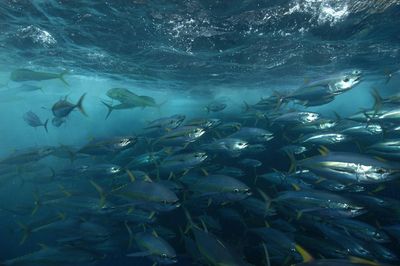


You've probably never seen a live tuna in the flesh. Perhaps you've spotted one on ice at a fish market, seared on a dinner plate, or mushed up in a metal can, but a swimming tuna is a rare sight for most people. That’s because only a small handful of public aquariums across the world dare to house them.
The most straightforward explanation behind their absence is simply that tuna are built for constant, fast-paced motion.
Their life as apex predators in the open ocean means they are astonishingly speedy, with some species reaching up to 80 kilometers (50 miles) per hour, and they can grow to incredible sizes, with record-breakers reaching up to 4 meters (13 feet) in length.
Fueling that pedal-to-the-metal lifestyle takes a powerful metabolism that's constantly on the go. Tuna achieve this through constant swimming, which forces water to rush over their gills and lets them continuously absorb the oxygen they need.
All of these factors mean tuna are far from ideal candidates for life behind plexiglass walls with a limited range.
Despite these hurdles, a few aquariums have risen to the challenge. The most notable is Monterey Bay Aquarium in California, which displays Pacific bluefin tuna and yellowfin tuna as part of its Open Sea exhibit alongside a host of other long-distance swimmers, including green sea turtles, hammerhead sharks, a massive school of Pacific sardines, and bonito.
Containing these characters requires a tank that’s absolutely vast: a 1,174-square-meter (12,643-square-foot) gallery holding 4.5 million liters (1.2 million gallons) of seawater, approximately twice the volume of an Olympic swimming pool.
The Monterey Bay Aquarium is – to IFLScience's knowledge – the only facility in the western hemisphere to publicly exhibit tuna (if you know of any others, let us know in the comments).
One of the only other places you'll find them is Japan, where a total of four aquariums keep tunas: Tokyo Sealife Park, Osaka Aquarium Kaiyukan, Okinawa Churaumi Aquarium, and Aquamarine Fukushima.
Given that Japan is a nation of renowned tuna lovers, and also holds the record for the highest number of aquariums per capita, that comes as little surprise.
However, even these world-class facilities run into difficulties dealing with their tuna tenants. Throughout late-2014 and 2015, dozens of the Pacific bluefin tuna at Tokyo Sea Life Park died under mysterious circumstances, until just one individual was left.
Experts struggled to find an explanation, but they eventually pinned the mass die-off on a combination of infectious disease, stress, and collisions with tank walls.
These window crashes aren't uncommon. Because tuna swim like torpedoes, it's not unusual for them to slam into a tank's transparent walls at speed, with fatal results.
An incident like this was reported in 2007, when a tuna died after colliding with the glass at Monterey Bay Aquarium. To help prevent these mishaps from occurring, the tank runs a bubble curtain at night, so that sleep-swimming fish can sense the presence of a wall and avoid going bump in the night. During opening hours, however, the glass must stay clear for visitors to gawp at.
Beyond being a spectacle, captive tuna also offer scientific insight into this remarkable tribe of fish. Monterey Bay Aquarium is home to the Tuna Research and Conservation Center, which has at least three large tanks of live tuna used for research.
As just one example, a study by Stanford University at the facility used stable isotope analysis to track how dietary changes altered the fish's tissues over time, which is the kind of longitudinal data that's only possible to gather from animals held in captivity.
While tuna will very occasionally appear in public aquariums, there are several sea creatures you'll never find there at all. Giant squids, for instance, can't be kept in captivity because artificial tanks cannot replicate the deep-sea pressure, near-freezing temperatures, vertical depth gradients, and other extreme conditions of their natural habitat.
The great white shark poses a different set of problems. Aquariums have tried to hold them in captivity many times, and every single attempt has ended in disaster or abject failure.

 1
1