Nature
 PUBLISHED



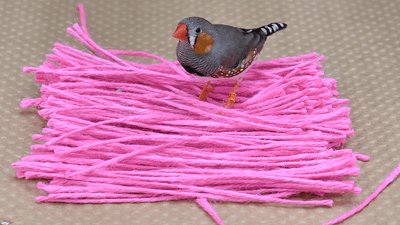


Animals often have preferences: dog lovers can tell you their pet’s favorite toy, or place to sleep, for example. In the bird world, zebra finch males are the main nest builders, and it turns out each has a favorite color for nest construction.
Researchers at the University of Alberta, Canada, wanted to investigate whether male zebra finches (Taeniopygia guttata) would show a stronger preference for a nest building material of a certain color, and whether they would choose to stick to that color when subjected to peer pressure, or switch to go with the group's majority.
In the wild, zebra finches are pretty social birds and aren't territorial. They breed and nest in close proximity in colonies in Australia, and fortunately they also nest year-round in a lab setting.
First, to test the color preference of the males, the experimenters gave them two bundles of string, one yellow and one blue. The males were then scored on how much time they spent with each bundle. “For instance, a male who spent 600 seconds interacting with yellow string and 400 seconds interacting with blue string would have an initial colour preference for yellow and would have a preference strength of 60%,” explain the authors in their paper.
The birds were then moved to another part of the experiment where they could see pairs of finches in nests already built out of yellow or blue string. Sometimes more were built with the color the bird preferred, and other times more were built with the disliked color.
After this, the finches were returned to the original room and built their own nest with yellow or blue string. The team were looking to see if the initial color preference shown by the male bird had been influenced by the colors of the nests they had seen, or if he would stick to his original choice.
The results showed that males who had a weaker preference in the first part of the experiment were more likely to go with the majority and construct a nest with their non-preferred color. However, those with strong initial choices were less likely to be socially influenced and stuck with their original color choice.
The paper is published in PLOS One.