


 Nature
 PUBLISHED





Humans love nostalgia, and while triggers like smell and taste can take us back, perhaps one of the most immersive is sound. Maybe it’s a lullaby from your childhood, or the opening credits to a particular TV show.
Sounds can transport us to our favorite memories, but also our favorite places, which is why it was like travelling around half the globe from my bed when I recently read zoologist Justin Anderson’s new book, Wilderness Songs.
In a chapter about the forest “orchestra”, he plays the sound of the Amazon rainforest waking up after a storm. What begins as a cacophony of chaos reveals itself to be a complex symphony of sound. Each layer of the forest knowing just what to say, and when to say it.
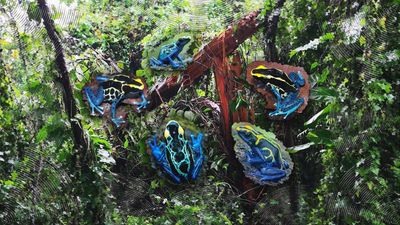
Frogs (bellies with billows that they are) feature heavily, but a standout story for this writer included the story of one frog that makes hardly any sound at all.
So how does this “voiceless” frog find love in the mess of noise that is rainforest life? By following the fallen trees, of course.
It’s one of dozens of stories you can immerse yourself in, as chapter by chapter Anderson offers QR codes that enable you to listen along as you read. From rare animal calls and curious deep-sea mysteries to novel ways of approaching conservation through sound, Wilderness Songs reveals just how much we can learn about our planet if only we stop and listen.
Across an expansive career producing wildlife documentaries, Anderson has collected many amazing sounds that are explored in the book. But still, if pushed, he will admit to a few favorites.
What’s a sound that takes you back somewhere?
JA: It probably changes all the time, but I think my favorite sound is the sound of skylarks. I've written about them in the book and for me, they've always been the sound of summer. I kind of measure the coming and going of the seasons with it.
It’s usually quite early in the year when it doesn't yet feel like summer, but you get one bright skylark appear in our local meadows here in Bristol. When I hear it, I know the summer is coming and it just fills me with joy.
You speak about going into the Amazon at night and switching off your torches. How does this removal of a sense enhance what you hear?
JA: I think it makes a huge difference because we're visual creatures. Our eyes are often our most dominant sense, and our ears are kind of secondary.
When you go into the rainforest at night, you’re looking for the thing you might bump into. You’re peering everywhere. Your head's spinning. You’re shining a torch and looking under leaves. So, we just took the time to turn off and then suddenly, it was like someone had turned the volume up. It was an amazing moment.
You mention how it can help you to pinpoint calls in the chaos of sound, but then there is this “voiceless” frog? How does it communicate in such a noisy environment?
JA: The rainforest is so full of life. There are more creatures there than anywhere else on the planet, and they're all kind of competing for the airwaves. So, some animals have evolved alternative ways to be heard.
One way of doing this is to shout louder. You've got animals like the howler monkey, which is the loudest land mammal that lives there. The white bellbird is the loudest bird, and I think the loudest insect in a rainforest is a cicada in Australia.
That's one way of doing it, but the tiny poison frog, known as the “voiceless” frog, is so small, it doesn't have the physiology to make a loud call. So evolution has kind of sent it in a different direction.
In order to find each other in the rainforest, what scientists think might be going on is that they're tuning in to the low-frequency sound of tree fall. When the tree collapses, it creates a boom that travels throughout the forest.
They don't know quite for sure if that's what the frogs are tuning in on. They think that might be a possibility, but they found lots of these frogs gathered in treefall areas, and it could be that's a way that they find each other so that they can mate in the forest.
How is sound being used as a tool for conservation?
JA: There's an amazing group called Rainforest Connection, and it was a kind of tech startup run out of this guy's garage in California. A guy called Topher White.
He'd done some voluntary work in forest conservation as a mature student, and he came up with a clever idea of repurposing old mobile phones to turn them into remote listening devices. What you do is you put these mobile phone devices up in the canopy and they're like a pair of ears. They just listen out.
By using machine learning and artificial intelligence, they can then program them to listen out for certain frequencies and certain sounds. And that includes the sounds of gunshots from poachers, or the sounds of chainsaws from people cutting down the forest.
They're also being used to listen for certain animals. They're really good for tuning into the sound of an endangered species and highlighting whether it's present in the area or not.
The latest iterations of these devices are called sentinels, and they've got an incredible array of solar panels to keep them running. They've been made available to lots of indigenous groups across the Amazon because one of the big problems is that indigenous groups are being left to police what's going on in their areas.
It's really hard for them to know what's happening. So, these sentinels from Rainforest Connection are actually helping them to tune in.
It's a really lovely combination of the ancient knowledge of the people who've always lived there, but also tech from California coming in and kind of allowing the people then to be able to act on it and alert the authorities, who can then go and intercept the miners, the poachers, the people who are doing illegal selling, more safely.
It’s a really interesting example of listening as a way to boost conservation.
Hungry for more CURIOUS questions? Head to the We Have Questions podcast for full-length audio versions of these curious conversations.
To access exclusive CURIOUS content first and receive the quarterly digital magazine, become an All Access Member.




 1
1