Nature
 PUBLISHED


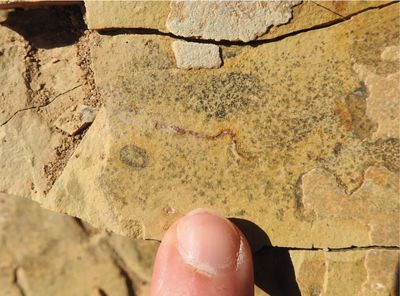


Once upon a time – more precisely, about 540 million years ago, in the pre-Cambrian era known as the Ediacaran – in a corner of what is now the very edge of Brazil, on the border with Bolivia, tiny organisms were wriggling about in the dirt. They didn’t have brains, or stomachs, or skeletons; they would barely be big enough to see with the naked eye, if only any naked eyes had yet evolved to see them.
Then, in 2017, the microscopic clues they left of their lives were found by palaeontologists – and things got really confusing. The fossils were barely there, and the creatures that seemed to have left them weren’t even known from the time they were left. Accepting the find at what appeared to be face value, in fact, would mean rewriting just about everything known about the fossil record so far.
Now, a new paper has figured out just what made it all so unlikely: it was wrong.
A find that shouldn’t exist
To an untrained eye, the Corumbá fossils aren’t much. They’re basically tunnels, each at most 600 micrometers in diameter, meaning you’d struggle to thread a hair from your head through one of them. But to the researchers who found them, they hinted at something monumental: the earliest known meiofauna on Earth.
“Our new fossils show that complex animals with muscle control were around approximately 550 million years ago, and they may have been overlooked previously because they are so tiny,” said Luke Parry, now an associate professor of palaeobiology at the University of Oxford, in a statement at the time.
“The fossils that we describe were made by quite complex animals that we call bilaterians,” he explained. “Most fossils of bilaterian animals are younger, first appearing in the Cambrian period.”
It was big news. Meiofauna are, more-or-less, the teeming underbelly of the entire planetary-wide ecosystem; they’re by far the most diverse group of animals on Earth – for context, they comprise about 25 of the 35 animal phyla out there – and can number in the sextillions of individuals in the case of, say, nematodes or copepods. Not only are they the food source for some of the tiniest creatures of land and sea, but they also enrich and aerate the soils where they live, keeping the whole environment healthy to its very foundations.
They’re also a really good indicator of the health of an ecosystem. By their very nature, the more meiofauna in an area, the more habitable it ought to be for all kinds of life: “Meiofauna are a really important group of organisms that play key roles in modern ecosystems,” says Bruno Becker-Kerber, a postdoctoral fellow in organismic and evolutionary biology at Harvard University and first author of the new study. “They likely played similarly important roles in the past.”
But that far in the past? “Finding meiofaunal traces in the Ediacaran would be very important and exciting,” Becker-Kerber tells IFLScience. “The advent of these small invertebrates might have drastically changed substrate oxygenation, along with other important geochemical processes.”
“Meiofauna […] if present, would have been disturbing the sediment by moving through it, creating burrows and affecting its porosity, oxygenation, and organic content,” he explains. “If that was the case, one could argue that the advent of meiofauna played a role in changing substrate chemistry and possibly creating a more suitable environment for further animal colonization and/or the use of sediments as a newly available ecological niche.”
To find them this far back in the fossil record, therefore, would be incredibly significant. There’s just one problem: according to Becker-Kerber’s new research, those 2017 fossils weren’t meiofauna at all.
A change of tune
Until now, it was basically accepted that the traces left in the Corumbá rocks were left by meiofauna. “The interpretation of these fossils as traces (meaning trails and burrows left in the sediment) of meiofauna was considered mostly settled,” Becker-Kerber tells IFLScience. “Only a few authors question[ed] their animal origins.”
But “the presence of meiofauna in the Ediacaran, and even in younger periods, is […] controversial and poorly understood,” he clarifies. That’s for good reason: as soft-bodied organisms, barely half the width of your pinky fingernail in length, it’s near-impossible for these creatures to leave an enduring legacy in the rock. “The burrows they make in sediments can disappear very quickly,” Becker-Kerber notes.
So Becker-Kerber and his colleagues took a closer look at the fossils – and we really mean a closer look, using cutting-edge technology to analyze the fossils at micro- and nano-meter scales. They reanalyzed the “traces” from 2017, they added in some newly discovered, very similar fossils from nearby Serra da Bodoquena… and they realized that the details just didn’t seem to add up.
I would say it is both a correction of the record and a set of new findings based on better-preserved specimens.
Bruno Becker-Kerber
“The morphology, preservation style, and spatial arrangement of the studied material support a body fossil origin rather than trace fossils produced by meiofauna,” reports the paper. “Many filaments are less than 20 µm in diameter, some as small as 6 µm, a size range more consistent with microbial remains than meiofaunal activity in the substrate.”
Not only was the size wrong, it was also inconsistent. The team found cells that “varied in shape,” they write, “suggesting that these filaments are likely to represent an association of different groups of microorganisms” rather than one animal burrowing around in the ground.
And sometimes, just knowing a puzzle is there can help you solve it. Once the possibility that these cells came from different organisms was on the table, their potential became more obvious: the larger ones were similar to red and green algae; the smaller ones could be cyanobacteria. Some contained pyrite – a mineral composed of iron and sulfur, and, when combined with the shape of the cells, a telltale sign of sulfur-oxidizing bacteria. “There are concave and convex partitions, coiled filaments, cells without sediment but containing organic matter,” Becker-Kerber said in a statement last week.
“This evidence is much closer to bacteria or algae than to mere marks of disturbance caused by animals.”
So, should his work be seen as refutation of the 2017 results? Not exactly. “I would say it is both a correction of the record and a set of new findings based on better-preserved specimens, which finally allowed us to resolve their biological affinities,” Becker-Kerber tells IFLScience.
“There is still a lot to be done to understand the origin and impact of meiofauna in the fossil record,” he says. “Science is always evolving, isn’t that right?”
Ancient puzzles, modern answers
Exactly which kinds of microorganisms created the fossils, the researchers can’t say. That’s not from lack of trying – even to get this level of detail is remarkable, and only really possible thanks to the level of technology available to the scientists at Campinas, Brazil, where the research was carried out.
As a Brazilian, I am extremely proud of our scientific infrastructure and of all the people who made it happen.
Bruno Becker-Kerber
“Most of the methods we used, including nanotomography and zoom tomography, would definitely not have been possible without a synchrotron,” Becker-Kerber points out. He used the MOGNO beamline at Sirius, the particle accelerator at the Brazilian Center for Research in Energy and Materials (CNPEM) – “I was a postdoc there when I ran some of the nanotomography analyses,” Becker-Kerber tells IFLScience. “I still plan to return for some of my new research topics.”
“This is why these large facilities are so important,” he says. “They help us shine new light on these tiny and ancient fossils.” Plus, he adds, “it was awesome to use the new Brazilian synchrotron, and as a Brazilian, I am extremely proud of our scientific infrastructure and of all the people who made it happen.”
To that end, he plans to move on to the TOMCAT beamline in Switzerland after completing his postdoc – once again using the highest of high-tech equipment to delve deeper into the history of life on Earth. Having resolved the paradox of the supposed Ediacaran meiofauna, he’s now focusing on the chemistry and morphology of other Cambrian invertebrates with his colleagues at Harvard.
In other words: watch this space.
“We have some new findings from the Harvard collections that I believe will be very impactful,” Becker-Kerber says. “But I still need to shoot some lasers and X-rays at [the] fossils before I get to the writing.”
The study is published in the journal Gondwana Research.