Nature
 PUBLISHED



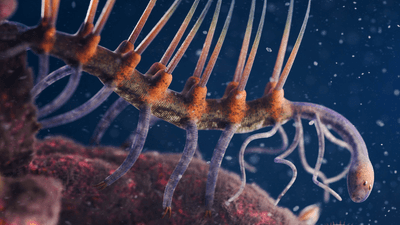


The Cambrian Explosion was a weird time for the creatures of planet Earth. It was a period of impressive change and growth, and many of the species alive then would go on to become the early ancestors of today's organisms. Of course, not all of them made it, and some were especially freaky-looking to modern eyes. Meet Hallucigenia sparsa.
Hallucigenia belongs to a group of worm-like marine creatures called lobopodians that lived during the Cambrian Period, roughly 500 million years ago. H. sparsa is one of the best-known Cambrian organisms, but details of its diet and feeding ecology aren't well understood.
The fossil the team studied is thought to be the only direct evidence of scavenging in H. sparsa, but despite the fossil being found over 45 years ago, this aspect had yet to be formally studied. The fossil came from the mid-Cambrian Burgess Shale in Walcott Quarry, Mount Stephen, in British Columbia.
H. sparsa's body measured between 5 and 30 millimetres long (0.2-1.2 inches) and its back featured seven pairs of spines that ranged in length from 0.8 to 10 millimeters (0.03-0.4 inches) depending on the size of the individual. Its undercarriage sported seven sets of "median" tentacles and three sets of shorter tentacles near the head.
The fossil, known as MCZ.IP.102104, consists of several specimens of H. sparsa alongside the carcass of a Xanioascus, an extinct comb jelly. Five of the H. sparsa specimens seem to be on the bottom of the comb jelly carcass, suggesting swarm-like behavior while looking for and feeding on prey.
This helps researchers piece together what life was like for H. sparsa, since its gut morphology, the lack of fossilized gut contents, and its frankly wacky mouthparts make putting together a dietary list challenging.
The team could even work out that the comb jelly's body was altered after it died, including rupturing of the body wall. They suggest the jelly likely settled on the seafloor after its death, where it was then scavenged by a group of seven H. sparsa.
The H. sparsa specimens, by contrast, show no sign of damage, suggesting they were alive up until the point they were buried in the sediment. This fossil represents a snapshot of feeding ecology and behavioral interaction dating back 500 million years.
It is suggested that H. sparsa fed on these gelatinous carcasses by sucking out the body fluids with its large head. The strange creature doesn't possess teeth to break down tougher prey, and a fluid-based diet also explains the simple gut structures and lack of digestive glands.
While it would initially seem that H. sparsa lacks modern counterparts, the team thinks present-day sea spiders could be a suitable analogue. They also have a slow-moving lifestyle and multiple limbs for locomotion and anchoring themselves.
The paper is posted on the preprint server bioRxiv and has yet to undergo peer review.