Nature
 PUBLISHED
 6
6


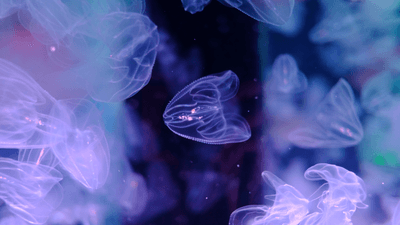


A chance observation has led to an astonishing discovery for a group of scientists studying the comb jelly, Mnemiopsis leidyi. When injured, it appears these curious ctenophores can fuse together to form one individual and even share some bodily functions.
The team was keeping a population of comb jellies in a seawater tank when they noticed an unusually large individual with a strange body shape. It looked as if two jellies had fused together, but it was hard to imagine this could be the case
I was also quite shocked when I found that paper
Dr Kei Jokura
“I was very surprised,” study author Dr Kei Jokura of the University of Exeter, UK, and National Institutes of Natural Sciences in Okazaki, Japan, told IFLScience. “I was alone at the time, but I immediately went to show the other Grass fellows.”
Their suspicions were vindicated when Jokura stumbled across an old but very relevant study on comb jellies.
“Fusion in comb jellies (Mnemiopsis leidyi) was actually reported in 1937,” he added. “I was also quite shocked when I found that paper.”
Encouraged by this earlier description of successful grafting experiments in ctenophore tissues, the team decided to run their own experiments. They collected comb jellies from separate places found on separate days and kept them in close contact after having a section of their bodies removed.
Nine out of ten experiments showed that the comb jellies had successfully fused, and all of the fused pairs survived for the full three weeks they were kept in a holding tank. In that time, they developed shared bodily functions including synchronized muscle contractions – something that became clear when they prodded what was once one jelly and the whole fused body reacted.
“We were astonished to observe that mechanical stimulation applied to one side of the fused ctenophore resulted in a synchronized muscle contraction on the other side,” Jokura said in a statement.
The fused jellies also had merged digestive tracts that kept the whole blob sufficiently fed. That two comb jellies had little issue becoming one was clear to see, and as for how it was possible, it could come down to a sort of lack of self-awareness.
“Our findings suggest that ctenophores may lack a system for allorecognition, which is the ability to distinguish between self and others,” Jokura added. “Additionally, the data imply that two separate individuals can rapidly merge their nervous systems and share action potentials.”
Jokura plans to unravel the phenomenon with a future research focus on the nervous system of the fused comb jellies, using live imaging to directly observe how electrical signals travel between them.
The study is published in the journal Current Biology.