Nature
 PUBLISHED


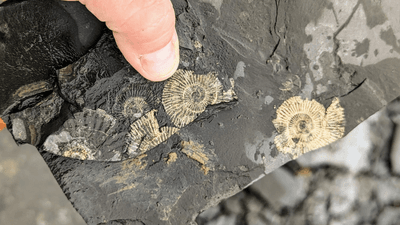


The minerals involved in the fossilization of ancient life can have a dramatic effect on how that fossil turns out. They might be opalized or rainbow-colored, or perhaps glittering like an ornate lump of gold.
Germany’s Posidonia shale is famous for its “fool’s gold” fossils, thought to be made of pyrite – not gold, but a naturally occurring iron sulfide. That was, until scientists took a closer look and discovered it was pretty hard to find.
“When you go to the quarries, golden ammonites peek out from black shale slabs,” said Rowan Martindale, an associate professor at the University of Texas Jackson School of Geosciences and co-author of the 2023 study, in a release at the time. “But surprisingly, we struggled to find pyrite in the fossils.”
Martindale and colleagues examined around 70 fossils from the Posidina Shale that date back 183 million years, encompassing a rich diversity of marine animals, including ichthyosaur embryos and squids with their ink sacs intact. They wanted to find out exactly what minerals had replaced these animals’ original cells in the fossilization process – something you can do by looking at crystal structures and testing for different elements.
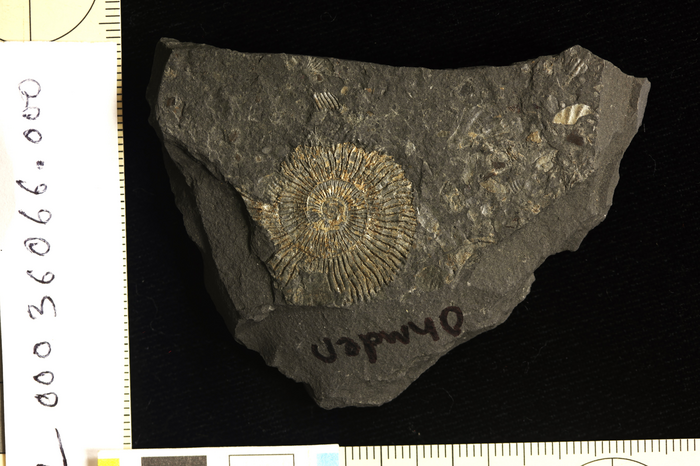
They discovered that every single fossil was primarily made up of phosphate minerals. So, not pyrite, but the fossils’ outer layer of black shale rock did contain microscopic clusters of pyrite crystals known as framboids. Lots and lots of framboids.
“I spent days looking for the framboids on the fossil,” added co-author Sinjini Sinha, a doctoral student at the Jackson School. “For some of the specimens, I counted 800 framboids on the matrix while there was maybe three or four on the fossils.”
As well as being sparkly, Posidina’s fossils are also remarkably well-preserved and the team wanted to establish why. So, they looked for clues about the ancient environmental conditions under which they were fossilized in samples of the surrounding rock. This, combined with a review of previous research, gave them the ammo they needed to construct a fresh hypothesis.
Pyrite forms in anoxic environments that we know can create favorable conditions for fossilization by removing scavengers, both large and bacterial. This halts decay and keeps body parts all in one place.
The fact that the Posidina fossils are primarily made of phosphorus tells us they couldn’t have fossilized in entirely anoxic conditions, however. Here, it seems a pivotal infusion of oxygen into the environment formed the tipping point needed to turn these remains into some of the best preserved and sparkliest fossils to be found in Germany.
“It’s been thought for a long time that the anoxia causes the exceptional preservation, but it doesn’t directly help,” said Sinha. “It helps with making the environment conducive to faster fossilization, which leads to the preservation, but it’s oxygenation that’s enhancing preservation.”

 1
1