Nature
 PUBLISHED



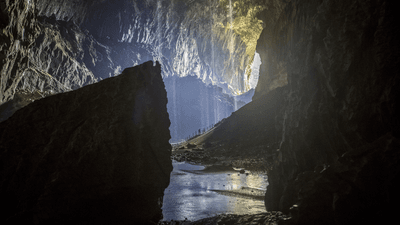


Cave exploration really captures the imagination because it’s one of the most literal forms of journeying into the unknown. While technologies such as LiDAR and ground-penetrating radar can now effectively peer underground, nothing beats going subterranean and finding out for yourself.
Just ask the six-strong team of speleologists who spent 3 months underground in Borneo back in 1977. Their mission? To map the mysterious caves of Gunung Mulu.
Now the centerpiece of a national park, Gunung Mulu (Mount Mulu) is a 2,376-meter (7,795.3-foot) sandstone mountain that's the second highest in the state of Sarawak, but it was the region’s limestone that lured in our cave enthusiasts.
The cavers were invited by the Royal Geographical Society to work with over 100 scientists and the local Berawan and Penan communities as part of a 15-month expedition to survey the mountain. During this time, they managed to explore an astonishing 50 kilometers (31 miles) of caves.
How to make a cave
Limestone is famously prone to erosion. This leads to the formation of cavities that can become caves, passages, and cenotes depending on how they develop.
This is because the rocks are mainly made from calcium carbonate, which is highly soluble in weak acid. All it takes is a bit of rain or groundwater to absorb some carbon dioxide, and over thousands of years the rock will gradually dissolve away.
But the cavers in 1977 were not the first to peer into the depths of Gunung Mulu.
The first scientific cave surveys were carried out in 1961 by the Malaysian Geological Survey. It surveyed the famous Deer Cave, named after the deer that were said to visit salt licks in the cave, as well as the first parts of the Cave Of The Winds, and Tiger Foot Cave.
Yet it wasn’t until 1977 that the caves were extensively revisited. The first major expedition took 15 months from June 1977 to September 1978. A distressing 3 months of which were spent underground.
During that time, they explored the known caves while surveying vast new passages they discovered along the way. This included a 25.7-kilometer (16-mile) passage of Clearwater Cave, which became one of their greatest achievements.
Record-Breaking Rocks
Today Clearwater Cave forms part of one of the world’s longest cave systems spanning 260 kilometers (161.5 miles) of mapped passages.
In fact, the caves of Gunung Mulu boast a number of world records.
The Sarawak Chamber is the largest cave in the world by floor area, at 700 by 400 meters (2,296.6 by 1,312.4 feet) with a height of 80 meters (328.1 feet). While at 120 to 150 meters (393.7 to 492.1 feet) in diameter, Deer Cave was the largest cave passage in the world when it was discovered, but has since been overtaken by Son Doong in Vietnam.
Arguably, the expedition's most important discovery wasn't any of the caves themselves, but the realization that they weren't isolated features. Instead, they form part of a vast underground drainage system, as the mountain sometimes revealed to them through "cave breathing".
As atmospheric pressure and temperature change outside a cave, air can get driven through interconnected passages, creating strong draughts.
This cave breathing happened to the cavers during a 1980s expedition, when Mulu Caves reported, "a howling draught from a small entrance revealed the way into the 1.3km Sakai’s Cave." The mountain's howling revealed its hidden architecture.
This kind of airflow is a product of cave meteorology where temperature, humidity, and airflow combine to create microclimates that form a weather system all of its own. This can sometimes cause cloud-like fog to develop within the caves themselves.
The perks of plumbing
What was thought to be a series of karst caves turned out to be an invisible world beneath one of Earth’s oldest rainforests. A hidden plumbing system that could transport water, recycle nutrients, and provide habitats and shelter for a diverse range of subterranean wildlife.
Today Gunung Mulu is home to thousands of plant species, as well as hundreds of birds, reptiles, amphibians, fish, and mammals – including bats. Lots and lots of bats.
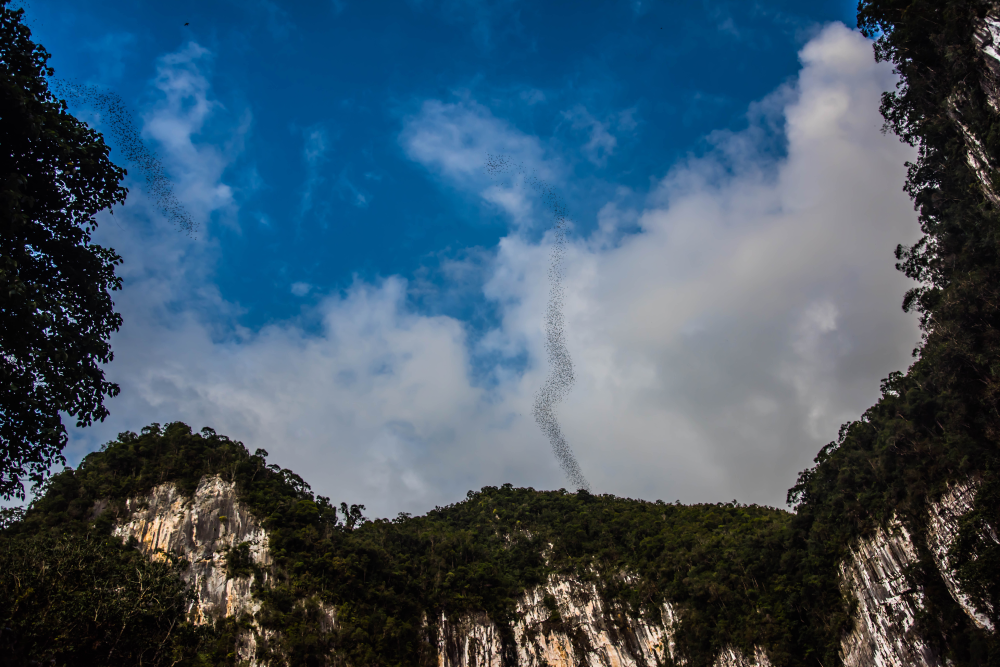
So far, 54 species of bats have been recorded in Gunung Mulu, some of which live there in their millions.
Deer Cave alone sees a daily “bat exodus” as between 2.5 and 3.5 million wrinkle-lipped bats soar into the evening to hunt for insects.
From underground fog to a tornado of bats, and a network of caves large enough to make humans appear like ants, Gunung Mulu National Park is an area of exceptional natural beauty with a heap of science to boot.
Hardly surprising, then, that it’s considered to be the crown jewel of Sarawak’s expanding network of national parks.
As a UNESCO World Heritage Site, it's granted strong legal protections. But the surrounding landscape faces increasing pressure from logging, oil palm plantations, and climate change.
Factors we need to fight if this otherworldly mountain range is to remain such a playground for Earth's only winged mammals (though if you're fond of gliders, boy do we have a fluffy guy for you).

 2
2