Nature
 PUBLISHED




Only an idiot would believe there was real gold in fool's gold, right? As is often the case, the normal rules don’t apply in the deep sea.
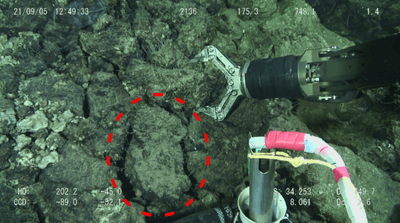
Japanese scientists recently explored the hydrothermal vent fields of the Higashi-Aogashima Knoll Caldera, a volcanically violent patch of the Pacific seabed far off the coast of Tokyo.
Stationed onboard the Shinsei-maru research vessel, the team used a robotic sub to document the ocean floor and scoop up samples from 700 meters (2,300 feet) below sea level. Back in the lab, they drilled holes into the samples and carried out a geochemical analysis of their innards.
The bulk of each sample proved to be pyrite, an iron sulfide ore often called "fool's gold" because of its shiny (albeit relatively worthless) golden appearance.
But inside, the samples were brimming with surprisingly high concentrations of genuine gold, as well as other chemical goodies like lead, copper, and arsenic.
Invisible gold
It comes in the form of so-called "invisible gold". Rather than clumping into a nice shiny nugget, the gold exists as microscopic nanoparticles embedded within the pyrite. Still, there's no shortage of it, with concentrations reaching as high as 19,231 parts per million.
The gold is the product of the strange geology churning on the seafloor and below. Hydrothermal vents are created by seawater seeping into cracks in the ocean floor, becoming superheated by magma in Earth’s red-hot mantle, then spurting back up to the surface.
During the journey, the water can take on a bunch of different minerals from within Earth's interior, including gold, which accumulate and settle as deposits on the seafloor.
To mine or not to mine
Scientists already knew that gold and arsenic levels tend to rise and fall together in certain types of pyrite, specifically the round, blob-like "framboidal" and "colloform" varieties. But in this study, most of the pyrite samples didn't strictly follow that expected pattern.
Pieces of pyrite with sharp, well-defined crystal edges had low levels of both gold and arsenic, while pyrite with less distinct edges usually had low gold, regardless of how much arsenic it contained.
It's generally understood that pyrite can hold more gold when it has more arsenic, and the study did find some of that pattern. However, they found that the highest gold concentrations occurred in colloform pyrite that also contained lead and/or copper, on top of arsenic.
Because of the many minerals found in these deep-sea regions, many countries and corporations are eyeing up the possibility of mining hydrothermal vents.
Japan is one of the nations most keen on the prospect, which is hardly surprising given it's an island nation surrounded by volcanically volatile seabed, eager to secure its own domestic supply of critical minerals and step back from its geopolitical reliance on China.
There's plenty of money to be made, but the impact on biodiversity and the environment could last decades.
The study is published in the journal Scientific Reports.

 1
1