


 Nature
 PUBLISHED



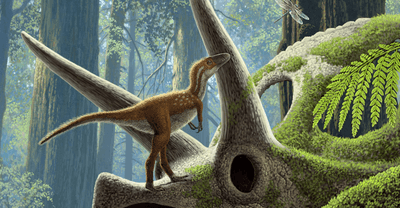


A foot bone from a baby Tyrannosaurus indicates it came out of the egg ready to chase its own food, rather than relying on its parents like most modern birds.
Nicholas Longrich at the University of Bath, UK, found the bone in a fossil collection held at the Royal Saskatchewan Museum in Canada, recognizing it as a metatarsal (foot bone) of a very young T. rex, something that hadn't been studied before.
Knowing that Eric Snively at Oklahoma State University had done extensive research on adult T. rex metatarsals, Longrich got in touch, and Snively saw the potential immediately.
“Metatarsals of a baby Tyrannosaurus might tell us if the babies were hunting right away or were in the nest for a longer time,” Snively said in a statement.
CT scans revealed the bone had no growth rings, so it must be from an individual less than a year old. On the other hand, the web of interconnected blood vessels and bone cells confirmed rapid growth, as one would expect of a predator that quickly balloons to enormous size.
Most crucially, Snively said: “We found canals in the bone that indicate they were quickly out of the nest and running around.”
Combined with previous evidence of worn teeth from T. rex hatchlings, this showed that, whatever the direct ancestors of birds were doing at the time, T. rex was not waiting around the nest for semi-digested meals from mum and dad.
“The babies were smashing into the bones of their food, just like giant adults,” Snively said. “Tyrannosaurus were unsafe at any size. Babies were quickly out of the nest and killing the heck out of things.”
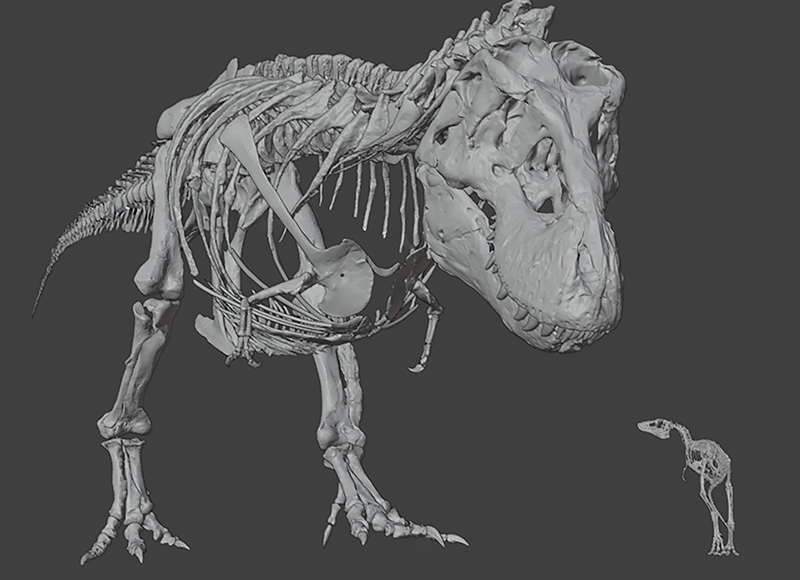
Although the babies were probably the size of an adult house cat, it’s unlikely they restricted their diet to mouse-size prey. The tooth wear is consistent with them consuming quite large animals.
Hands-on or hands-off parenting?
The authors conclude T. rex most likely laid 15-30 eggs in a clutch. Today, the number of eggs laid, or babies born, at one time, provides a strong indication of an animal’s approach to parenting, and there are good reasons to think this holds true for T. rex too.
“Because animals have limitations in what they can invest in the next generation, they can either invest in having lots of young, or invest a lot in their young, but not both,” said Longrich. “The small size of tyrannosaurs suggests they pursued the first strategy — they had lots of small young and had a light touch when it came to parenting.”
Nevertheless, light touch does not mean no touch. Some frogs lay thousands of eggs, and sea turtles around a hundred. If T. rexes didn’t feel the need to support their offspring at all, they might have produced a more turtle-like number of kids.
“There was probably a fair amount of parental investment, like nest guarding and guiding the young for a while, like in crocodilians and larger ground birds like ostriches. But the babies could fend for themselves pretty soon after hatching,” said Snively.
As the authors note, this matches the fact that “Dinosaurs were intermediate between more primitive reptiles and modern birds in their anatomy.”
If the lessons of Jurassic Park are ever ignored, that means if you encounter a clutch of cat-sized baby Tyrannosaurs, you can bet their parents will be keeping a watchful eye over them. So, best not to encounter even the babies unarmed, as it were.
That said, T. Rex eggs would have weighed 2.5-3.8 kilograms (5.5-8.5 pounds) if any omelet lovers were feeling particularly brave.
Most of these hatchlings will probably have died before reaching reproductive age, many quite young, yet fossils of very young Tyrannosaurs remain very rare. However, finding this one in an existing collection is a reminder there are probably plenty more sitting undescribed because no one has recognized what they had.
After the recent sale of an adult T. rex skeleton for $50 million, it’s terrifying to think what a baby might attract, given how much rarer the fossils are.
“The research documents the full range of size for Tyrannosaurus individuals as they grew, and how throughout their life, they held similar ecosystem roles as bone-crushing predators in their size classes,” Snively said.
The paper also describes the bone of a hatchling Gorgosaurus libratus, another carnivorous theropod of the same era. The two individuals would have weighed about the same, despite an adult Gorgosaurus eventually growing to be just a quarter to a third of a T. rex’s weight.
The authors propose that Gorgosaurus laid about 15 eggs at a time, pursuing a modestly more bird-like approach to parenting.
The study is open access in Biology.



 1
1