


 Nature
 PUBLISHED


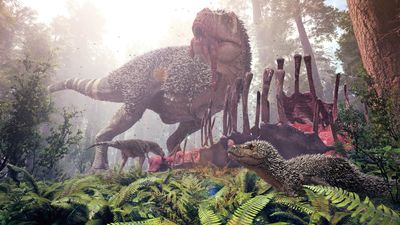


A new study of growth patterns in the bones of Tyrannosaurus rex has contradicted previous reports that it stopped growing in its mid-20s. The work also adds to recent evidence indicating that specimens previously thought to be juvenile T. rex were a different species.
Dinosaur bones can tell us a lot about a creature at the time it died, but they’re less revealing of how it got there. In theory, we could piece together the life cycle from hundreds who died at different ages, but we almost never have enough specimens for that. It’s also not always clear where to place the individual a bone belonged to on an age chart.
Fortunately, bones have annual growth rings, similar to those of trees, at least for species that lived in places with strongly seasonal climates. Nevertheless, reading these rings is far from straightforward, and a new assessment argues we’ve been doing it wrong for the most famous dinosaur of all.
Previous studies of T. rex growth rings concluded they grew until around the age of 25, and then stopped. This was more of a gradual-slowdown than a sharp halt, but nevertheless, the finding has been the basis of a lot of thinking about the T. rex lifestyle, and more tentatively for its relatives.
However, Dr Holly Woodward Ballard, a professor of anatomy at Oklahoma State University, and co-authors have tested this data using a combination of additional specimens, new techniques for reading the growth rings and statistical approaches not previously applied to this field. They conclude that it was only at about 40 that T. rex growth stopped, although it was slow for quite a while beforehand.
“This is the largest data set ever assembled for Tyrannosaurus rex,” Woodward Ballard said in a statement. “Examining the growth rings preserved in the fossilized bones allowed us to reconstruct the animals’ year-by-year growth histories.”
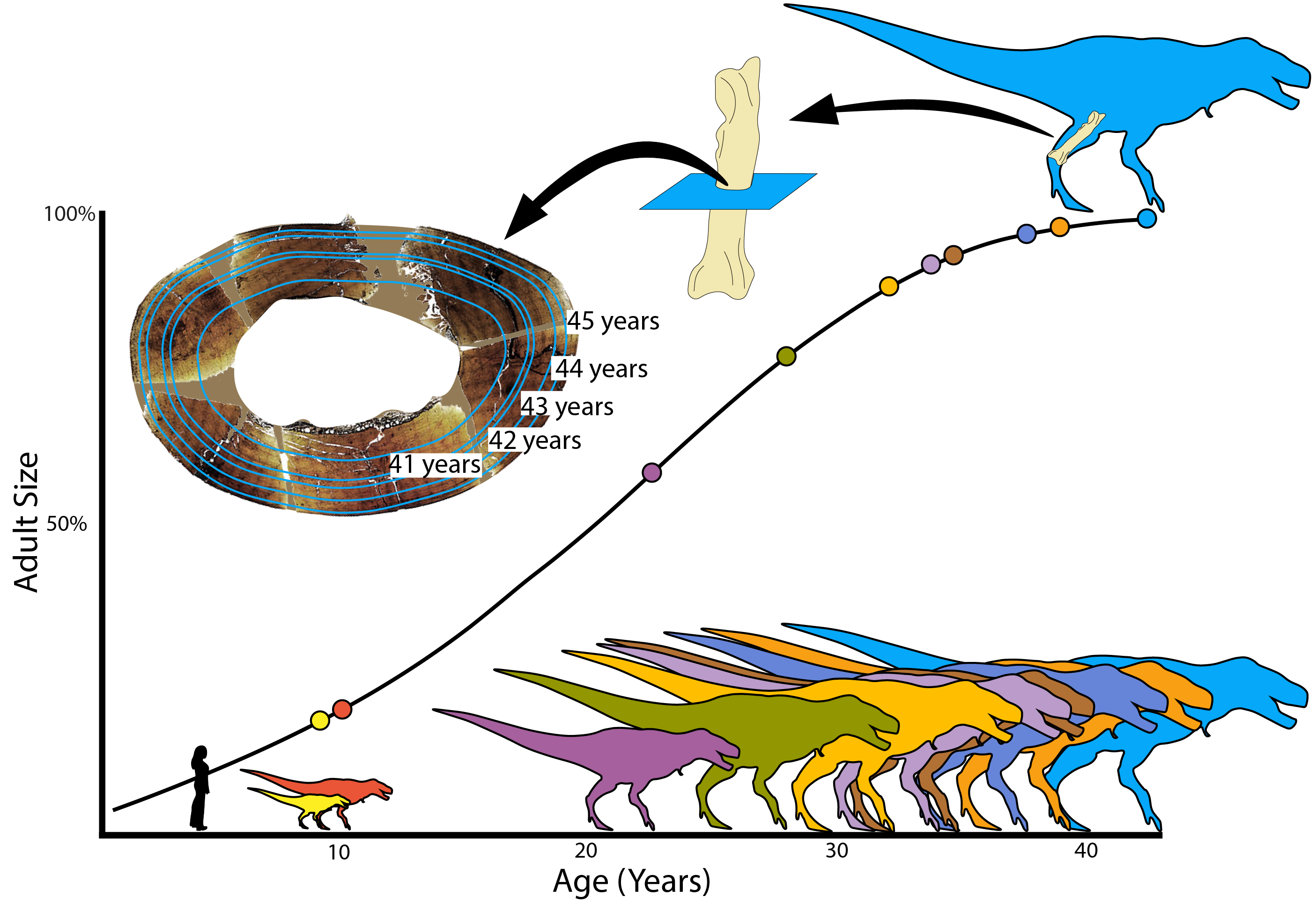
Unfortunately, unlike tree rings, T. rex bones effectively erase the growth history prior to 10-20 years before they died. On the plus side, no one is killing the dinosaur to measure the rings.
Another obstacle to making sense of growth rings is that sometimes growth slows down dramatically, forming what is called an annulus. Woodward Ballard told IFLScience these can be seen under ordinary light, but are particularly clear under cross-polarized light. Using polarization, Woodward Ballard’s team found extra annuli that had been missed by other teams studying these specimens.
“[They’re] very faint and often not visible at all in normal light, and not as bright as a typical annulus in polarized light,” she told IFLScience. Nevertheless, they have banding that indicates growth slowed down at these points, helping create a more accurate picture of the dinosaur’s growth cycles.
“We came up with a new statistical approach that stitches together growth records from different specimens to estimate the growth trajectory of T. rex across all stages of life in greater detail than any previous study,” said Nathan Myhrvold of Intellectual Ventures, who led the statistical analysis. “The composite growth curve provides a much more realistic view of how Tyrannosaurus grew and how much they varied in size.”
Putting all this together, the authors reached two conclusions. Two of the much smaller specimens in their sample had a fundamentally different growth curve from the others, and T. rex growth continued for around 15 years longer than previously suspected.
“Just based on the histology data we have, we can only say these individuals were growing differently, but now why. Woodward Ballard told IFLScience. “They could be a different species, but they could just as well be sick, injured, or dwarfed individuals as those are found in any animal population.”
The possibility that some specimens classified as juvenile T. rex were instead fully grown members of another genus, Nanotyrannus, has been debated for decades. A recent study concluded there were at least two species in the Nanotyrannus genus, and specifically that the two outliers in this study were nanotyrannosaurs, not T. rex. In an addendum to their paper, Woodward Ballard and co-authors expressed their satisfaction that their findings align with that paper.
The extended growth period suggests that T. rex probably occupied different niches as it grew, rather than racing to reach its maximum size as quickly as possible. “That could be one factor that allowed them to dominate the end of the Cretaceous Period as apex carnivores,” said co-author Jack Horner, a Presidential Fellow at Chapman University.
Nevertheless, it seems that domination was not so complete that Nanotyrannus couldn’t find its own smaller hunter niche.
Some species today keep growing throughout their lives, but Woodward Ballard told IFLScience this was unlikely to be the case for T. rex. Modern animals produce a tissue known as the external fundamental system (EFS). “The EFS is found when the bone stops growing in length, so that if you find it in a leg bone, you can assume the whole animal has stopped the majority of its increase in body length,” Woodward Ballard told IFLScience. “We only found this tissue in the largest, oldest T. rex specimens in our dataset.” Nevertheless, its presence indicates these T. rex had reached their final size.
The study is published in PeerJ.



 1
1