Nature
 PUBLISHED
 2
2


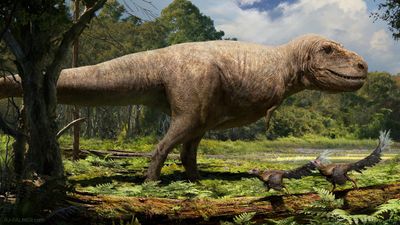


Tyrannosaurus rex, the tyrant lizard king, brought to terrifying life in Jurassic Park and recently with a more up-to-date, realistic appearance in Apple TV’s Prehistoric Planet, was famously a little lacking in the arms department.
You wouldn’t say it to one’s face, of course, and it’s obvious that not everyone can bring a gun show like Deinocheirus… but those graspers do stand out as, well, rather puny.
“Its tiny arms probably couldn't do very much. How could they?” Professor Steve Brusatte at the University of Edinburgh told IFLScience. “They were pathetic, just as long as my arms. Really, it's ludicrous; human-sized arms on a bus-sized animal.”
It’s something palaeontologists have discussed for decades, and now a study by PhD student Charlie Scherer and his colleagues at University College London and the University of Cambridge provides the strongest evidence yet for how T. rex and many other carnivorous theropod dinosaurs ended up with their weedy forelimbs.
“Our key finding is that it's the overall strength of the skull which played the greatest part in determining the evolution of smaller arms,” Scherer told IFLScience, “with the skull taking over as the primary weapon.”
So as the jaws got stronger, the arms got smaller. You would be right to think this isn’t a totally new concept: even a cursory look at a T. rex skeleton suggests its enormous jaws did most of the heavy lifting, rendering the arms somewhat useless.
But it isn’t the only potential explanation, and where you have multiple hypotheses (including one arguing it was to avoid chomping one another’s limbs off in a feeding frenzy), the only way to sort them out is by diving into the evidence.
“Most of us have acknowledged that the development of the more powerful skulls and jaws needed to dispatch large prey quickly would have reduced the need for powerful forelimbs,” Dr Thomas R Holtz, Jr. at the University of Maryland, who was not involved in the study, told IFLScience.
“[But] we all have only so much time to actually collect the data and run the analyses, and so there are many speculations that require a new generation with more time or freedom on their hands (being at the start of their careers) to take the measurements and generate the algorithms to test these.”
Scherer and his colleagues gathered forelimb, skull, and body size measurements for 85 species of theropod dinosaur, of which they had enough information in 61 cases to calculate the ratio of skull length to forelimb length.
The team also developed a new method to quantify skull "robustness," combining measures like the ratio between skull length and height, estimated bite force based on the size of muscle-attachment points, and the degree to which the skull bones were fused together.
They found five lineages of theropod with reduced forelimbs, defined as having a skull-to-forelimb ratio of greater than or equal to one: Abelisauridae, Carcharodontosauridae, Ceratosauridae, Megalosaurinae, and Tyrannosauridae (the latter, of course, being the family to which T. rex belongs).
The strongest model predicting forelimb size across carnivorous theropods took both skull robustness and body size into account, which together explain around 35 percent of the variation between species.
Skull robustness alone, however, was the single strongest predictor – accounting for around 29 percent of interspecies variation on its own, roughly as powerful as the degree to which smoking rates predict lung cancer across populations.
The findings push back against a simpler competing hypothesis: that arm reduction is just a consequence of getting bigger – a phenomenon biologists call allometry, where different body parts face some constraint that prevents them from scaling in proportion with one another.
Think of what would happen if you blew a horse up to the size of an elephant. As it got bigger, its legs would have to become thicker relative to the rest of its body to support its increased mass. It’s why modern-day elephants and prehistoric sauropods, some of the largest land animals of all time, have legs that could pass for tree trunks.
The suggestion is that a similar thing might have been going on with carnivorous theropods, where decreasing arm length was just an unavoidable consequence of getting bigger. Prior work had already called this into question, citing the examples of large herbivorous theropods – like the aforementioned Deinocheirus, which walked around with an impressive set of pythons despite being in a similar weight class to T. rex.
As noted in a 2022 paper that performed a similar though less extensive analysis of the relationship between the skull and arm length in Carcharodontosauridae and some other theropods, the existence of such animals indicates an ecological explanation rather than reduced relative arm length simply being a function of size.
“The counterexamples had long been recognized,” Holtz told IFLScience. "Large-to-giant therizinosaurs, oviraptorosaurs, and ornithomimosaurs have large arms but small heads on long necks, since these were all herbivores or omnivores and didn't need to dispatch large prey with massive bites."
While the kind of analysis in this paper can't tell us what drove the association between jaw robustness and arm length, Scherer and colleagues make the case that evolution was probably pushing more for robust jaws than smaller arms, with the latter following suit.
If it had been the other way around, with smaller arms coming first, you would expect the existence of predators with reduced forelimbs and a relatively weak skull, the researchers say, which they argue would put them at a disadvantage – giving up the grappling before the biting was good enough to compensate.
“In palaeontology, it’s hard to be certain about what has directly caused evolutionary changes (because to do that, we’d need to run an experiment, which is impossible),” said PhD student Milly Mead at the University of Edinburgh, who was not involved in the study. “But the authors show the next best thing – that there’s a clear association between shorter forelimbs and more robust skulls in these dinosaurs.”
There are still more lines of evidence that can be brought to bear before we have a full picture of what was going on with T. rex, its relatives, and their arms. One thing this study didn’t investigate, for example, is how the musculature of the arms changed as they got proportionally smaller.
Indeed, a study on this topic by Dr Greg Funston at Stony Brook University is currently in the works. That research may uncover other evolutionary implications of the way short arms developed that could help explain more of the variation between species.
The study is published in the Proceedings of the Royal Society B: Biological Sciences.