Nature
 PUBLISHED





Not long before the Earth plunged into its greatest ever cold period, the super-continent Rodinia broke apart. In the process, it created one of the most astonishing geological structures of all time.
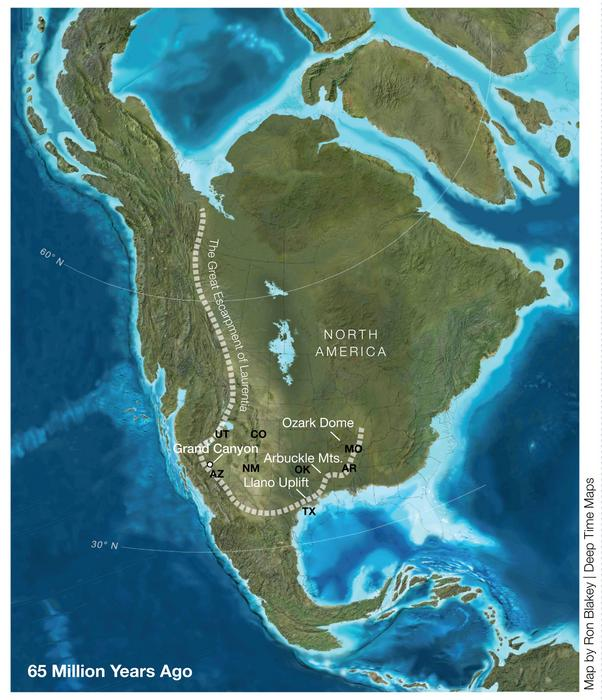
A vast cliff formed, geologists claim, that ran from where Arkansas lies today along a hooked route almost the entire way to Canada’s north coast. If the “mega-escarpment” was real, then it eroded away more than 600 million years ago. But the team proposing its existence suggests that it could explain why the Grand Canyon’s walls skip a billion years.
Deep canyons are a geologist’s delight. These huge walls expose layer upon layer of rock, and in the process reveal the history of the area’s geology in sequential form.
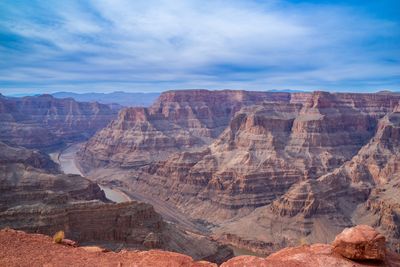
Sometimes, however, time is missing from these layers, with rocks of very different ages placed immediately on top of each other with nothing from the intervening eras in between. This is known as an unconformity, and the world’s most famous example lies in the Grand Canyon.
A missing chunk of rock
Where lesser unconformities might skip tens of millions of years, the Grand Canyon suddenly jumps from rocks 1.7 billion years old to 540 million years, missing 1.2 billion years like ripped-out pages of a book.
But it’s not the only place where this happens. Some geologists consider the same gap to be so widespread they call it the Great Unconformity, and have proposed various explanations, such as extreme erosion from globe-encasing glaciers.
Others dispute that the Great Unconformity is a worldwide phenomenon at all. But its presence in the Grand Canyon is not in question, and needs explaining.
Professor Thomas Gernon of the University of Southampton is part of a team that thinks erosion of the mega-escarpment was responsible.
Gernon and colleagues propose that the crust and upper mantle thinned where the rift that broke up Rodinia formed, creating a temperature contrast and convection in the mantle of the Earth. This in turn triggered a migrating wave which uplifted parts of the surface.
The newly exposed basement rocks then eroded away, explaining their absence in the canyon.
Modern-day counterparts
The break-up of the supercontinent Gondwana around 180 million years ago created some of the world’s greatest existing escarpments, particularly in South Africa and Brazil.
These run parallel to the line along which Gondwana broke up, and were created by a similar migrating mantle wave.
After the two newly-formed continents of South America and Africa separated, the uplifted land was exposed to the weather and started to erode. This caused the escarpment to retreat, explaining why the remnants are now found further inland on both continents.
After more than a hundred million years, they are a shadow of their former selves.
This is thought to mirror what might have happened in what would become North America during the Cambrian Period.
When the break-up of Rodinia occurred, where the Grand Canyon is today would have been around 500 kilometers (300 miles) from the continental margin. This is similar to the distance South Africa and Brazil's escarpments are from the South Atlantic.
How to lose 1.2 billion years
The scientists think that this led to the stripping of up to 8 kilometers (5 miles) worth of rock from the surface, which had taken a billion years to build up. Once that erosion stopped, new layers then started to form.
This would explain why these younger layers sit directly on top of much older material, creating the Great Unconformity that was then exposed when the Colorado River cut into the landscape.
The authors argue their explanation is compatible with some alternatives, with multiple unconformity-forming processes combining.
However, they note the Great Unconformity is the most notable “on continents that originally clustered around the ‘core’ of Rodinia,” and therefore broke up around the same time, indicating this was the primary cause.
“This long-lived tectonic landscape provides a missing piece in understanding why erosion associated with the Great Unconformity varies so dramatically across the southwestern US,” Gernon said in a statement.
“Our work suggests that tectonic uplift related to continental rifting and breakup created both steep slopes and high ground, providing the mountainous terrain that rivers and glaciers could readily erode.”
Such an epic geological phenomenon inevitably affected the western half of North America, directing rivers and sediment flows, and dictating which areas were submerged during the Ediacaran and early Cambrian eras.
“Today’s escarpments in Africa, Brazil, India and Antarctica provide windows into the forces that shape continents over hundreds of millions of years.” Gernon added.
“By comparing Grand Canyon’s ancient history with active landscapes like the Great Escarpment of South Africa, we’re able to see North America’s most iconic geologic landmark in an entirely new light.”
The study is open access in Geology