Nature
 PUBLISHED


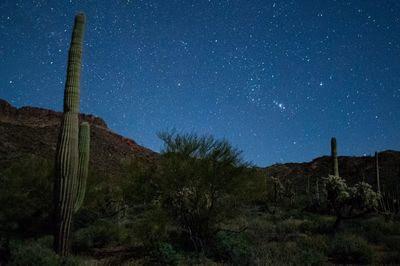


In 2001, Flagstaff, Arizona was named the first International Dark Sky City. Now there are more than 200 places named as Dark Sky areas across the world. The newest member of that list is also in Arizona, as Organ Pipe Cactus National Monument becomes an official Dark Sky Park.
International Dark Sky places are chosen to help preserve areas to be kept free of artificial lights and excess light pollution. This in turn can help protect species that benefit from a nocturnal environment, as well as helping preserve the night sky as a natural resource for everyone to enjoy.
Organ Pipe Cactus National Monument sits along the border of Arizona and Mexico, and showcases the Sonoran Desert through hiking trails and an extraordinary collection of animal and plant species that are specially adapted to the extreme temperatures and high sunlight. There are even 26 species of cactus that call this area home, and don’t forget the psychedelic slime-producing Sonoran Desert toad.
"Organ Pipe Cactus National Monument, in the heart of the Sonoran Desert, is proud to receive this Dark Sky designation,” said Superintendent Raquel Montez in a statement. “Protecting the monument’s night environment honors a landscape where the stars have guided and inspired early peoples for generations and continue to shape our understanding of this place today.”
There are six classifications of Dark Sky places, including Parks, Sanctuaries, Reserves, Communities, and Urban Night Sky places – there's even a Dark Sky Island. Each category has its own set of criteria and factors in things like who owns and maintains the spaces, the populations living nearby, and the sky quality.
This involves using a Sky Quality Meter, to measure luminance in magnitudes per square arcsecond. This can help document changing light pollution levels and acts as a reference point for sky brightness levels. Though counterintuitive, a higher number is a reflection of a darker sky.
“This recognition reflects focused efforts to modernize park infrastructure in ways that support the surrounding natural environment. National parks remain among the most valuable places in the country to experience the clarity of star-filled skies, from distant galaxies to the planets that define our shared night,” said Montez.
Excessive light pollution is a complex problem. Recently, a study suggested that light pollution had increased by 16 percent worldwide in just a nine-year timeframe, though those changes were not happening in the same way across the world. Nighttime light has even been linked to Alzheimer’s disease in people under 65, due to the disruption of circadian rhythms, though many other disease risk factors also play a part.