Nature
 PUBLISHED


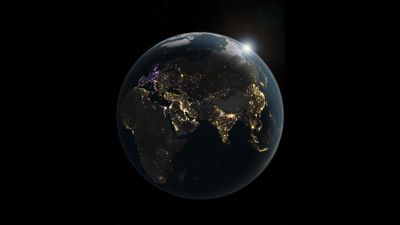


A new study on the changes in artificial light at night has revealed that the situation is far more complex than previously thought. While the data shows a net global increase in light emissions, as reported by other work, it also reveals that at smaller scale, changes are quite varied.
The international team, led by Tian Li and Zhe Zhu from the University of Connecticut's Department of Natural Resources and the Environment, studied 1.16 million daily satellite images that focused on the inhabited landmasses of our planet. The total area was about 3.51 million square kilometers (1.36 million square miles).
Previous work has suggested that the night sky is actually getting brighter faster than we predicted, and from analyzing the images, this study found that between 2014 and 2022, the night sky had a net increase of 16 percent, which outpaced population growth. And that’s not the whole story.
“When you would read news articles related to [artificial light], it was often said that everything is getting brighter, places are getting brighter. And, you know, on the on the whole, for the whole world, for whole continents, this is basically true,” co-author Professor Christopher Kyba, from Ruhr-Universität Bochum, told IFLScience. “What was missing until now was to look at sort of the finer scale: what's happening at these smaller scales?”
The net figure combined a 34 percent increase in light emissions that was offset by 18 percent of dimming globally, but the rate of change was not the same everywhere. About 51 percent of that 3.51 million square-kilometer area saw gradual changes, 14 percent experienced abrupt changes, and 35 percent experienced both.
Abrupt brightening could be related to construction sites and other projects flooded with lights, while abrupt dimming is related to energy instability, conflicts, and other societal disruptions. The team followed the trends at a pixel level to be able to have a clearer understanding of how the night is changing.
“There are places that grow gradually, there are places that dim gradually, there are places that are sort of stable and then have a sudden change or are growing gradually and then suddenly have a change and then are on a new trajectory,” said Professor Kyba.
The team stress that the idea that the night is getting brighter everywhere is not entirely accurate. In particular, less populated, more remote areas and natural reserves have been able to remain stable in terms of light pollution.
This study shows the importance of Earth monitoring from space, but also highlights the limitations of night time monitoring, which has two main satellites for high-resolution views (one American and one Chinese), compared to monitoring during the day.
“We're still right at the very beginning of studying lights with satellites, even though it's been around for several years. The comparison between night and day is just very, very different,” Professor Kyba told IFLScience. “Daytime is way better for satellite data.”
In the last few decades, light pollution has experienced a dramatic increase, thanks in part to more efficient LEDs. Artificial light affects plants and animals, and has also been linked to a series of serious health conditions, including Alzheimer’s disease.
The study is published in the journal Nature.