Nature
 PUBLISHED


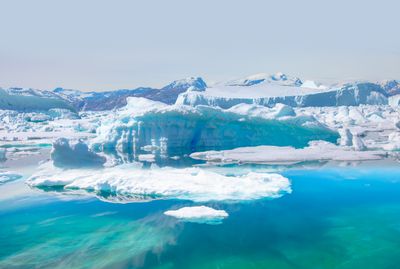


New modeling suggests that Greenland’s meltwater may weaken the Atlantic Meridional Overturning Circulation (AMOC), a massive ocean conveyor belt that provides warm, salty water to the north Atlantic – but it is potentially reversible. This result contrasts with years of concern that the conveyor belt could simply shut down altogether, resulting in extreme global climate impacts.
The AMOC plays a vital role in the world’s climate. It brings warm, nutrient-rich water up from around the equator towards the north Atlantic Ocean and then carries cold water south. In doing so, it transports a large amount of heat to places that would otherwise be significantly colder due to their latitude.
For instance, parts of Northern Europe are kept much warmer than other places on the same latitude, such as parts of Canada.
For some time, scientists have worried that the AMOC is vulnerable to climate change. We know that its strength has waned in the past, especially around 8,200 years ago. But human-driven climate change is impacting it faster as it is becoming warmer and meltwater from shrinking glaciers is flowing into it, making it less salty.
Scientists are particularly concerned that meltwater from the Greenland ice sheet could cause the whole thing to collapse, an event that would cause massive shifts in the temperatures and climate around the North Atlantic.
Although there is significant uncertainty concerning this vital ocean system, existing models suggest that it could lower temperatures around the UK by around 5°C (9°F) and Western Europe by around 1-3°C (1.8-5.4°F). This is only a rough estimate, and it could be worse.
But with these seemingly small changes would come a significant reduction in rainfall across Europe, impacting agriculture, and more violent storms and stronger winds. On a broader level, these shifts would make the Northern Hemisphere drier and the Southern Hemisphere wetter, on average.
On top of this, the collapse could lead to a feedback loop where more carbon dioxide is released into the atmosphere, leading to further global warming.
Early warning indicators are already suggesting that the huge web of ocean currents is destabilizing and reaching a potential tipping point. Although other work has identified some previously overlooked mechanisms that may help stabilize it, the ability for the AMOC to weaken suddenly and irreversibly has been repeatedly demonstrated by many ocean and climate models.
But will this be the case? Well maybe not, though with an emphasis on the maybe.
In a new study, a team of international researchers used state-of-the-art models to see how Greenland’s meltwater would affect the AMOC. They found that while it would indeed weaken the conveyor belt under projected climate change conditions, these changes were not necessarily permanent.
The team note that most models of climate change tend to focus on atmospheric warming and how it will impact the AMOC. However, they don’t tend to model how the Greenland meltwater will influence this process.
In this latest study, the team found that taken together, the AMOC will become 60 percent weaker due to atmospheric warming and a further 20 percent weaker due to Greenland meltwater. But this does not lead to full on, rapid collapse.
Moreover, they found that the AMOC can actually recover across time – by around 2400 – if atmospheric carbon dioxide levels decrease by 1 percent every year from 2250 onwards.
“We found that the combined CO2- and meltwater-induced AMOC weakening in our model was neither abrupt (with respect to external forcing) nor irreversible (on centennial timescales), characteristics often associated with climate tipping points,” the team explain in their paper.
But this is not a cause for celebration, nor is it a reason to think that changes to the AMOC will not cause real problems for Europe.
If the AMOC weakens by 80 percent, then this alone will devastate crops in Western Europe and lead to significantly harsher winters and freezing conditions, while also disrupting monsoon rains in the Southern Hemisphere.
The team also stress that these are the results based on a single model, “and should be interpreted as such.”
They explain that in “addition to comparing the response in different climate models, future studies should assess whether the overturning changes shown here are robust in high-resolution ocean models, which resolve mesoscale eddies.”
“Last, given that the uncertainties regarding the impact of Antarctic meltwater on the AMOC are considerable, simulations assessing the concurrent impacts of Greenland and Antarctic meltwater on the AMOC in long-term scenarios are needed in the future.”
One point that can be taken from this study is that human action makes a difference. If we can curb our reliance on fossil fuels then there is a chance to reverse the changes that are already occurring.
The study is published in Science Advances.