Nature
 PUBLISHED
 2
2





A new species of Portuguese man o' war has been discovered floating in the waters of northeast Japan. Spotted by a student-led research group, the discovery marks a species that has never been seen before in the area, raising questions about shifting distributions of marine creatures due to the effects of climate change.
"I was working on a completely different research project around Sendai Bay in the Tohoku region, when I came across this unique jellyfish I had never seen around here before," said second author Yoshiki Ochiai in a statement. "So I scooped it up, put it in a ziplock bag, hopped on my scooter, and brought it back to the lab!"
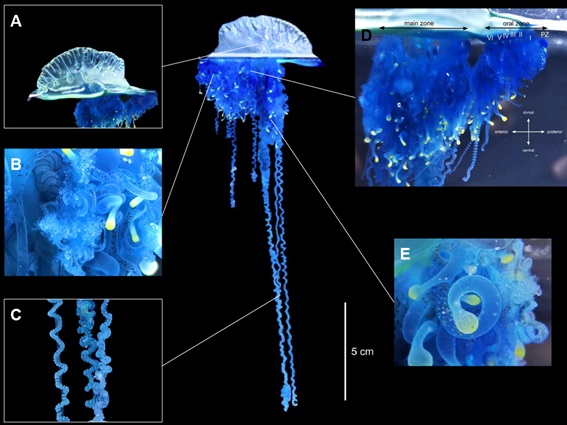
What Ochiai had found was a new species of Physalia or Portuguese man o' war, which has now been named Physalia mikazuki or the crescent helmet man o' war after Sendai's famed feudal lord Date Masamune, who had a crescent moon design upon his helmet.
Earlier this year, it was proven that the Portuguese man o' war is not just one species, but actually four different ones, all with their own distribution. In Japan, one of the species, Physalia utriculus, is known to be found from Okinawa to Sagami Bay. It was thought that this was the only species in the genus to be found in that region, but DNA sequences and public databases have helped the team work out that the new species, P. mikazuki, had been living in that area all along. It was only recognized as a new species, however, when it was spotted in a completely new area, the Tohoku region.
"It was a very involved process recording all the unique body structures that distinguish it from the other four species of Physalia," explained first author Chanikarn Yongstar. "I looked at each individual part, comparing its appearance to old tomes where scholars drew out the jellyfish anatomy by hand. A real challenge when you look at just how many tangled parts it has."
To find out how the new species had ended up so far north, the team ran computer simulations that suggested that ocean currents – in particular, the Kuroshio Current, which has moved approximately 2 degrees in latitude north between 2023-2024 – could have carried the species north due to high sea surface temperatures.
"I ran a particle simulation - which is like dropping bright red beach balls in the water, then making data-based estimations to track where they will end up days or months later," said study author Muhammad Izzat Nugraha. "We were excited to find that in our simulation, all the beach balls essentially made a trail from Sagami Bay up to right where we found the "crescent helmet man-o-war" in the Tohoku region."
This represents a problem not just due to the climate change aspect, but also to the other species in the area. Physalia is known to prey on fish larvae and can also pose a threat of stinging to beachgoers in this region.
The paper is published in Frontiers in Marine Science.