Nature
 PUBLISHED



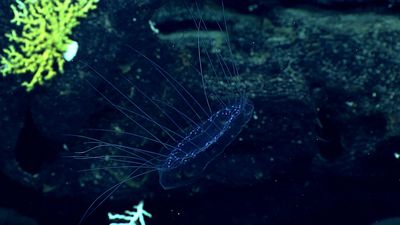


Bloody-belly comb jellies, dinner plate jellies, Christmas tree siphonophores, and sea elephants were among the weird and wonderful names of the many strange invertebrates spotted on a recent journey to the deep sea off Southern California.
This gang of gelatinous creatures was spotted as part of a recent 10-day expedition by researchers from the Monterey Bay Aquarium Research Institute (MBARI).
You can check them all out in the video below.
Onboard the research vessel David Packard, the MBARI team sailed from Monterey Bay to the Channel Islands of southern California to explore the ocean’s various depths.
Although marine life doesn't pay any attention to state boundaries, they noticed how the populations near southern California were subtly different from those found off the coast of central California and Washington State.
Into the midnight zone
One area of focus was the midnight zone, a portion of the ocean beyond a depth of 4,000 meters (13,123 feet) where sunlight no longer penetrates the water. This depth also features crushing pressure, hundreds of times greater than the atmospheric pressure we experience at surface level.
To observe the wildlife in this pitch-dark abyss, special equipment was a must. Their remotely operated vehicle (ROV) was armed with a low-light camera, built in-house by MBARI engineers, that allowed the team to capture the bioluminescent light displays of these deep-sea creatures.
On top of dives with the ROV, the crew was kept busy around the clock with other duties. Each morning they sent scuba divers to collect comb jellies and other species living in the sunlit surface waters. When night fell, they used trawlers to sample animals that had migrated upward to the surface to feed under the cover of darkness.
Along with the more familiar cast of characters, the team observed several undescribed comb jellies and a new species of Erenna siphonophore (a kind of close cousin to jellies) with elaborate, dangling, tentacle-like lures. They also witnessed a type of siphonophore that had previously only been seen in the waters of the Gulf of California.
How life survives in these dark depths
A jelly-like form is well-suited for living under intense pressure since there are no bones or delicate organs to be crushed. MBARI scientists have also found that many of these deep-sea jellies carry enzymes that help them thrive amidst extreme temperature and pressure conditions that would be too much for most life on Earth.
Other life forms have made their home in the deep through other adaptations, however. Take, for instance, the deep-sea myriad shrimp seen during the recent expedition. Like other crustaceans, they have an extremely tough exoskeleton to bear the pressure.
They have also lost the use of their eyes. After all, why waste energy on visual information when you spend your entire existence in near-total darkness?