Nature
 PUBLISHED


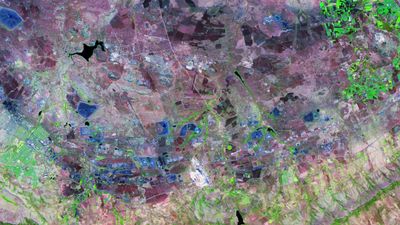


To the untrained eye, the Bushveld Igneous Complex (BIC), in northeastern South Africa, is kind of unassuming. It’s roughly the same size as West Virginia – or, for metric users, the Republic of Ireland – and taller many times over than even the world’s biggest waterfalls, but it is, at first glance, just a rocky, grassy outcrop.
At second glance, though, things get a bit more interesting. The rocks that jut out from the ground are strikingly layered, like an ancient, petrified opera cake. The ground is filled with platinum – about 70 percent of the world’s supply is mined there – as well as palladium, rhodium, chromium, and vanadium.
And even deeper within, there are the microscopic traces of the earliest life on Earth – and, perhaps, clues to finding it elsewhere, too.
The Bushveld Igneous Complex
Spanning approximately 66,000 square kilometers (25,500 square miles), the BIC is technically a large igneous province, formed through millennia of overlapping magma deposits. But past that, its origin story is kind of mysterious: “Despite years of extensive study in the area, geologists have not reached a consensus about how this igneous complex formed,” notes NASA’s Earth Observatory.
“One hypothesis is that the complex is a single, massive feature shaped like a giant bowl,” it explains. “Others suggest that it consists of discrete, disconnected structures. In either case, the complex might have received multiple infusions of magma from different sources.”
For a long time, the question wasn’t just how the place was formed, but when. Until the 1990s, many geologists thought the BIC must have taken more than 100 million years to form – based on uranium-lead dating techniques, it was a reasonable conclusion to draw at the time. But the march of technology has yielded far more accurate methods, and modern measurements have shown that the BIC formed in less than 10 million years.
Now, that’s quite quick, as geological process go – especially when you consider just how long the complex has been around overall. When the BIC was formed, more than 2 billion years ago, the Earth was only just coming out of the Great Oxidation Event – the 400-million-year-long period of time during the Paleoproterozoic era in which as much as 99.5 percent of all life, such as it was, died off. A day was just 15 hours long. Pangea was still eons away. It was, in very fundamental ways, a very different planet.
All of which makes the BIC, and the Transvaal Supergroup of geological regions to which it belongs, incredibly interesting.
A glimpse into the past
Two billion years is a very long time. Scientists can hypothesize about what the world was like that far back in prehistory – they can use cutting-edge dating techniques and sophisticated mathematical models to back their arguments up – but actually seeing something from back then? Something vaguely similar, even? Think again.
Unless, of course, you get lucky. Back in 2024, a team of geologists from the University of Tokyo did just that, making a discovery that could dramatically change what we knew about the very earliest life on Earth.
“We didn’t know if 2-billion-year-old rocks were habitable,” lead author Yohey Suzuki, an associate professor from the Graduate School of Science at the University of Tokyo, said in a statement at the time. But when the team investigated a drill core from a Bushveld rock, they really did find life – albeit a form unlike any we’re used to today.
“In the case of the 2-billion-year-old mafic rock investigated in this study, veins with microbial colonization are associated with clay minerals,” the team explained. “The tight sealing of the veins with clay minerals prevented the contamination of microbial cells from the drilling fluid. In turn, indigenous microbes are immobile and survive in the veins by metabolizing inorganic and/or organic energy available around clay minerals.”
In other words, microbes from up to two billion years ago had survived until the present day, hanging on inside the tiny veins and crevices of the rock. And they made sure to prove it wasn’t just modern contamination, too – these microscopic organisms were the real, pre-eukaryotic deal.
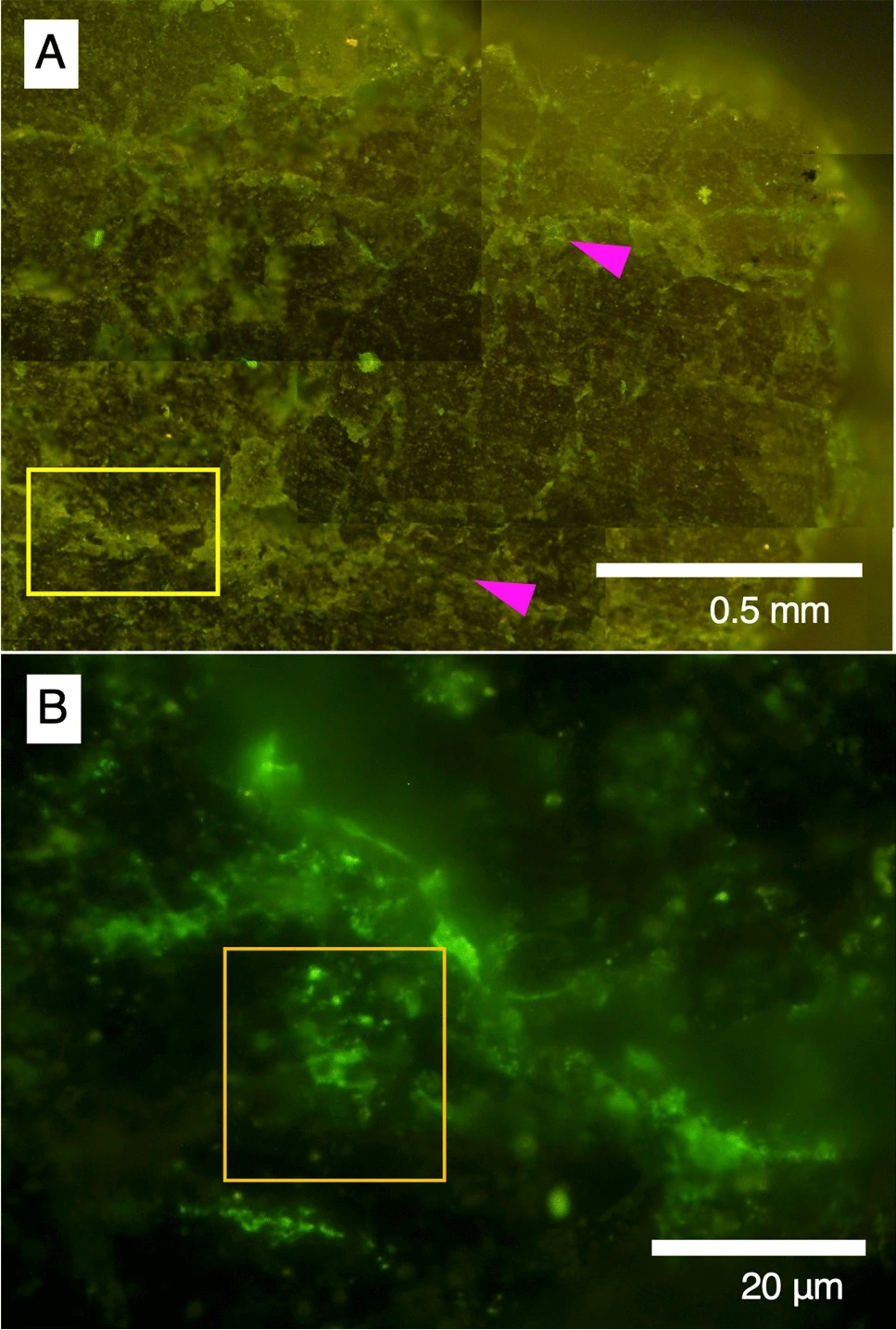
“This is a very exciting discovery,” Suzuki said. “By studying the DNA and genomes of microbes like these, we may be able to understand the evolution of very early life on Earth.”
Of course, it raises a doozy of a question: how the heck could anything survive that long? And, well, there are two parts to that answer. First, there’s the caveat that the microbes themselves may not be as old as the rock: “The microorganisms themselves are not 2 billion years old,” pointed out University of Göttingen geobiologist Manuel Reinhardt, who wasn't involved in the study, to New Scientist. “They colonised the rocks after formation of cracks; the timing still needs to be investigated.”
The Japanese team, however, believes that the microbes got in very shortly after the rock’s formation – and the secret to their eon-length lifespan seems to be a kind of extreme evolutionary inertia.
“The metabolic activities of subsurface microbiomes are exceedingly slow under survival mode,” explained the team, “leading to an estimated turnover time ranging from several thousand to million years.” For example, they pointed to the Candidatus bacterium Desulforudis audaxviator, found in the Mponeng Gold Mine about 100 kilometers (62 miles) southwest of the BIC, which has “undergone minimal evolution since 55–165 million years ago” thanks to its habitat deep under the Earth’s surface.
As a result, they offer a unique peek into some of the very earliest life on Earth – and, Suzuki hopes, somewhere else, too.
Per ardua ad astra
So, we have microbes found living inside what seemed like dead rock, apparently without needing sunlight or oxygen, for billions of years.
You know where else has dead rock and a lack of oxygen? Mars.
“I am very interested in the existence of subsurface microbes not only on Earth, but also the potential to find them on other planets,” Suzuki said. “Finding microbial life in samples from Earth from 2 billion years ago and being able to accurately confirm their authenticity makes me excited for what we might be able to now find in samples from Mars.”
It may have been optimistic, but as it turned out, it might not have been as far-fetched as it sounded. Late in 2025, NASA announced what it said “could be the clearest sign of life that we've ever found on Mars” – and it came in exactly the form Suzuki had predicted.
“Perseverance came upon Cheyava Falls in July 2024 while exploring the ‘Bright Angel’ formation, a set of rocky outcrops on the northern and southern edges of Neretva Vallis, an ancient river valley,” NASA reported at the time. “The rover’s science instruments found that the formation’s sedimentary rocks are composed of clay and silt, which, on Earth, are excellent preservers of past microbial life.”
Of course, nothing is confirmed just yet – to truly understand what’s going on at Bright Angel, we’d ideally be able to analyze the rocks here on Earth, and that’s basically a non-starter under the current Trump administration.
But whatever the results turn out to be, Suzuki thinks we’ll learn something about life on other worlds: “I am now almost over-expecting that I can find life on Mars,” the researcher said in 2020. “If not, it must be that life relies on some other process that Mars does not have, like plate tectonics.”