Nature
 PUBLISHED
 1
1


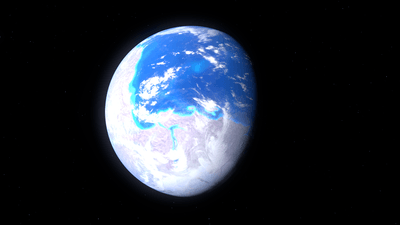


The Earth evolves on a timescale unfathomable to humans. A hundred years ago, a thousand, even 10,000 years ago, none of us were alive – but the planet? Give or take a few degrees Celsius, it was basically the same as today.
No: to see the continents and oceans move, we have to zoom much further out. The last time the Earth was dominated by a single supercontinent was 200 million years ago, when dinosaurs were just beginning to stretch their limbs on Pangea; its transformation into the seven (ish) continents we know now has been an ongoing process ever since.
Over such long timescales, it can be understandably difficult to build an accurate picture of the Earth’s past. We know about Pangea, the Jurassic supercontinent; we know that it was formed when Gondwana and Laurasia, the two giant landmasses which preceded it, fused together some 150 million years earlier than that. We’re even pretty sure about Rodinia, which dominated the planet for some 350 million years between 1,130 and 750 million years ago, and Nuna, twice as far back again as that.
But outside of these big hitters, the picture is pretty much up for debate: a mishmash of disputed theories and hypothetical landmasses that geologists are still trying to figure out the details of. And perhaps the most controversial of all, at least recently, is Pannotia.
The southern supercontinent
What was Pannotia? Well, for those who believe it existed, it was the continent that upended the planet – literally. Today, two-thirds of all the Earth’s landmass is found in the Northern Hemisphere; Pannotia – a name which derives from the Greek “pan”, meaning “all”, and “nótos”, meaning “south” – existed almost entirely below the equator.
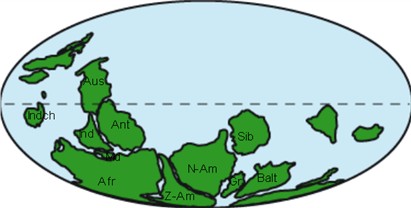
For a supercontinent, it was relatively short-lived. Pannotia was “born” about 600 million years ago, and broke up about 40 million years later, making its lifespan less than one-quarter the length of Pangea or Rodinia. But its brief time here was nonetheless impactful: “Pan-African mountain building and the fall in sea level associated with the assembly of Pannotia may have triggered the extreme Ice House conditions that characterize the middle and late Neoproterozoic,” argues one 2009 paper by geologist, paleogeographer, and creator of the Paleomap Project, Christopher Scotese, and “the amalgamation and subsequent break-up of Pannotia may have triggered the ‘Cambrian Explosion'.”
It's been in the geological record since 1970, and for a long time “the geologic evidence in support of such a supercontinent was stronger than for any other supercontinent excepting Pangea,” argued R. Damian Nance back in 2020. It jibed with the fossil and geological records; with evidence from “ocean chemistry, the stable isotope record, biogeochemical cycles, zircon age peaks, et cetera,” Nance explained. “The list goes on and on.”
“All of these ‘proxy’ records are consistent with the assembly and breakup of a supercontinent some 600 million years ago,” he said.
There’s just one problem: Pannotia may never have existed.
A continental controversy
Around 25 years ago, while most of the world was worrying about the Millennium Bug, a controversy was rocking paleogeology.
“Of the various pre-Pangean supercontinents that have gained recognition […] Pannotia might be expected to be best understood since it was the first to be proposed,” muses one 2022 paper on the supercontinent’s story. “But at the very time that the supercontinent cycle has gained popularity, the existence of Pannotia has come into question.”
“Cases have been made both in favor and against the reality of this supercontinent, and in many studies its existence is acknowledged,” the paper notes. “But in an increasing number of recent studies, Pannotia is either disputed, discounted, or ignored.”
So, why did the continent fall out of favor?
Some of it is just the march of technology. “With the advent of direct data on the positions of the continents stemming from the paleomagnetic record, coupled with increasingly precise age dates […] its existence [has] come into doubt,” Nance explained.
Essentially, the more accurately we were able to date the supposed evidence for Pannotia’s existence, the less convincing it was. Rocks that were thought to have come from the collisions that formed the supercontinent turned out to be far too young; continental crust that should have turned up well after Pannotia’s breakup, meanwhile, seems instead to predate it.
And without this direct evidence, the indirect arguments for Pannotia’s existence lost much of their foundation. “The hallmarks of collisional assembly are straightforward,” David Evans, professor of Earth and planetary sciences and director of the Yale Paleomagnetism Laboratory, who was arguing against Nance in 2020, said. “But those of an alleged global-scale 500-million-year-old breakup tend to be highly ambiguous in their interpretation.”
Then there’s the existential implications. “If Pannotia really existed, then the supercontinent cycle would seem to be speeding up rapidly, from Nuna (1,600 million years ago) to Rodinia (900 million) to Pannotia (600 million) to Pangea (300 million),” Evans pointed out. “We would need to find a deep-Earth explanation for the dramatic quickening of this global rhythm, and we might expect that the next supercontinent should be occurring right around the corner, as it were.”
Was this the end for Pannotia? Well, not quite.
A broken theory
Pannotia may have been a supercontinent, or it may not – but here’s the thing: either way, it probably did “exist”. At least, in a way.
Let us explain: the argument doesn’t seem to be over whether these landmasses came together around the south pole, but whether they managed to all come together in one big lump. The counter is not that something we could call “Pannotia” never existed at all – it’s that it had already started breaking up by the time it could have fully assembled itself, or that it was more of a transition phase than a continent in its own right.
“In my opinion, we have an emerging vision of the 600-to-500 million-year-old collisions as a mere ‘stepping stone’ toward the younger, complete gathering of Pangea,” argued Evans, “rather than a complete Pannotia assembly/breakup cycle.”
It’s been more than half a century since Pannotia was first proposed, and in that time it’s gone from basically accepted to a hub of controversy. Today, some geologists take its existence as a given; others argue in favor of its existence; others against it. The jury is, evidently, still out.
But perhaps that’s not such a bad thing. “Uncertainty is an essential aspect of any healthy science,” Evans pointed out. “We should all be prepared to rethink our beliefs if new data require us to do so.”
Regardless of whether Pannotia was a supercontinent or not, it still had a huge impact on the Earth’s evolution – and whatever the verdict turns out to be, we’ll learn something interesting.
But for now, this is one scientific question where we have time to figure things out.
“The current Pannotia debate is one where we all accept that the rocks have been around for hundreds of millions of years, and they can probably wait a little longer for us to sort out their history — so there’s no need to get too distressed about a few remaining unresolved issues,” Evans said. “Instead, if we work together we might discover some truly amazing things about our planet.”