Nature
 PUBLISHED
 5
5


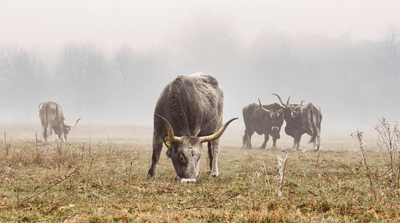


The Scottish Highlands could soon greet some new residents: a breed of super-beefy wild cattle that have been designed to possess the appearance of aurochs, the untamed ancestor of all domestic cattle that fell into extinction 400 years ago.
Known as tauros – yes, like the Pokémon – the cattle have been selectively bred in the Netherlands to resemble and behave like the aurochs as closely as possible. Although still technically defined as domestic cattle, they can reach up to 180 centimeters (5 feet 11 inches) at the shoulder, similar in size to aurochs, and possess the bold long horns of their extinct ancestors.
In a new project set to launch in 2026, the charity Trees for Life is hoping to reintroduce a herd of 15 giant tauros to the 4,000-hectare (9,884-acre) Dundreggan estate near Loch Ness, Scotland.
Their presence will have an important knock-on effect throughout the local ecosystem. Their stomping and dropping of poop will help to build healthy soils that host insects and other invertebrates, which in turn become prey for birds, small mammals, and reptiles. The fur of the aurochs will also help to distribute seeds around the environment, while their strong appetite will ensure that the landscape doesn’t become too overgrown with vegetation.
“Introducing the aurochs-like tauros to the Highlands four centuries after their wild ancestors were driven to extinction will refill a vital but empty ecological niche – allowing us to study how these remarkable wild cattle can be a powerful ally for tackling the nature and climate emergencies,” Steve Micklewright, Chief Executive of Trees for Life, said in a statement.
“Our Tauros Project is about looking forwards while learning from the past as we restore nature-rich landscapes that support wildlife and people, and are resilient to future environmental challenges. We also want to give people the chance to experience in a safe way the awe and wonder of getting close to an animal that feels really wild," added Micklewright.
The animals will be kept under the legal and animal welfare requirements of keeping cattle. Although the tauros will effectively be treated as farm animals, they hope to allow them to live as wild as possible. Warning signs and safety protocols will be in place to allow people to encounter the animals in a "managed way," although the researchers insist they aren't overly aggressive.
Aurochs were once found throughout Eurasia and parts of North Africa. As shown by their regular appearance in prehistoric rock art, they played an important part in human culture, not to mention their significance in the natural world.
While they disappeared from Britain around 1300 BCE, a few populations held on to existence until just a few centuries ago, with the last known individual dying in Poland in 1627.
Their legacy is still going strong, though. Modern-day cows are essentially a domesticated form of wild aurochs, meaning their DNA still clearly survives in some cattle breeds. Scientists have hence been able to interbreed ancient cattle breeds that are genetically and physically closest to the aurochs, thereby creating the so-called tauros.
The rewilding project in Scotland will be a first for the UK, but several hundred tauros have already been introduced to different parts of mainland Europe, such as the Netherlands, Czechia, Croatia, Spain, and Portugal.