Humans
 PUBLISHED


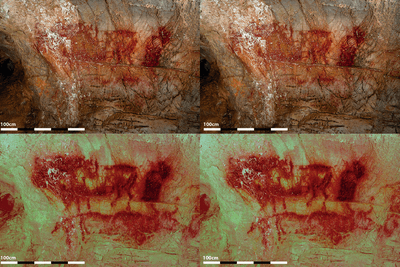


A closer look at a collection of cave art in Spain has revealed a number of long-lost animal figures and shapes that haven’t been appreciated for thousands of years. The researchers say their work highlights the importance of how rock art is often a three-dimensional medium that can’t always be understood in a two-dimensional image.
The ancient artworks can be found at La Pasiega cave in Cantabria, an autonomous community in northern Spain. This part of the Iberian Peninsula is rife with prehistoric rock art, with some 100 caverns containing examples of etchings and paintings from the Upper Palaeolithic (between 50,000 and 12,000 years ago).
Within the La Pasiega cave, there are a number of artworks depicting horses, deer, an extinct species of cattle called aurochs, quadrangular symbols, stripes, and painted dots.
To gain a deeper understanding of the rock art collection, a team from Complutense University in Madrid imaged the walls using stereoscopic photography. This is the technique used to create images that appear three-dimensional by using two slightly off-set images, not dissimilar to the effect seen in novelty red-cyan 3D goggles.

This revealed that some of the rock art contained features that were previously not seen by the naked eye. Likewise, the imaging even revealed some totally new animals, three previously unrecognized animal figures, including two horses and an aurochs.
This is because the imaging revealed that the natural dips and dents of the cave wall were frequently used by the prehistoric artist to complete their illustrations. As the researchers note, their study indicates that archaeologists and anthropologists should get to grips with using three-dimensional imaging techniques when documenting cave art if they wish to capture the full story.
“Stereoscopic photographs have allowed us to recognize correlations between images and irregularities of the rock walls of the cave, which are not perceptible in two-dimensional photographs,” the study authors write.

“Palaeolithic rock art should not be defined only by drawn, painted or engraved marks but also by the topographical features of the rock on which they are inscribed – the two elements cannot be separated,” they added.
The study is published in the journal Antiquity.

 1
1