Humans
 PUBLISHED
 10
10





The way you look may be determined by the name your parents gave you at birth, according to a scientific paper. After conducting a number of experiments involving adults, children, and artificial intelligence, the researchers found that people’s faces tend to evolve throughout their lifetime in order to suit their names.
“Children do not look like their names yet, but adults who have lived with their name longer do tend to look like their names,” write the researchers. “These results suggest that people develop according to the stereotype bestowed on them at birth.”
Why does a Michael look like a Michael?
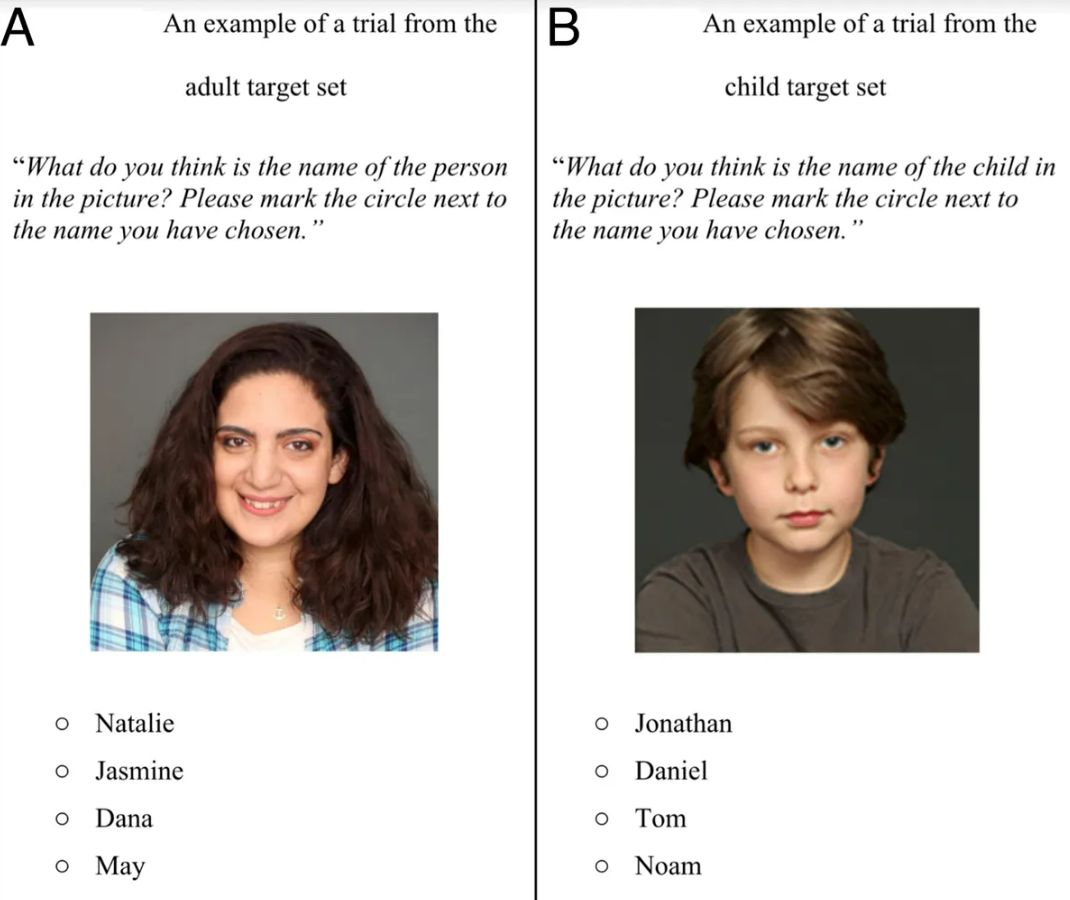
To reach this conclusion, the study authors first asked both kids and grown-ups to try and match pictures of faces to names. Both age groups were able to correctly guess the names of adults based only on their appearance, with a success rate considerably higher than chance.
However, none of the participants managed to consistently match children’s faces to the correct name. According to the study authors, this suggests that people start to look like their name as they mature.
To corroborate this finding, the researchers used a machine learning system to analyze the similarities and differences between the faces of people with the same name.
“We found that adults with the same name have more similar face representations than those with different names, but children with the same name do not show this pattern,” they write, thus backing up their previous conclusion.
Finally, the team artificially aged images of children’s faces in order to represent how they might look as adults. When viewing these photos, participants were unable to correctly match faces to names, as they had done for natural adults.
A self-fulfilling prophecy
Furthermore, similarities between the doctored faces of kids with the same name did not exceed the chance level when run through the machine learning system. Taken together, these results all point towards the fact that we don’t innately look like our names, but that our faces change to match our label “through a self-fulfilling prophecy.”
"Our research highlights the broader significance of this surprising effect - the profound impact of social expectations,” said study author Dr. Yonat Zwebner in a statement.
Also known as “social structuring”, the application of tags, labels, and stereotypes has been theorized to influence our physical and psychological development, although quantifying the strength of this effect has until now proved challenging. Commenting on her team’s results, however, Zwebner insists that "social structuring is so strong that it can affect a person's appearance.”
“These findings may imply the extent to which other personal factors that are even more significant than names, such as gender or ethnicity, may shape who people grow up to be," she says.
The study was published in the Proceedings of the National Academy of Sciences in 2024.
An earlier version of this article was published in July 2024.