Nature
 PUBLISHED
 11
11


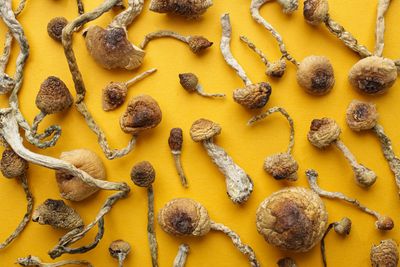


One of the great mycological mysteries just took another bewildering turn, as it turns out that psilocybin may not actually protect magic mushrooms from their insect predators. This means we still don’t know why shrooms evolved to produce this mind-altering substance, although whatever function psilocybin plays, it’s sure to be an important one.
We know this because genetic studies have shown that the ability to create psilocybin has evolved at least twice in completely unrelated mushrooms. Given that nothing happens by accident in nature, the fact that this compound has arisen more than once means that it must be highly beneficial for the mushrooms.
Known as convergent evolution, the phenomenon whereby separate species independently evolve the same attributes can be seen throughout the animal kingdom, with eyes emerging in vertebrates and cephalopods, and wings appearing on birds and mammals. However, while the advantages of all these traits are blindingly obvious, it’s less clear why psilocybin should be so readily selected for by the evolutionary pressures driving the development of magic mushrooms.
Up to now, the leading theory has been that the psychedelic compound deters predators. On the one hand, this seems pretty likely, especially when you consider that many insects carry the types of serotonin receptors that psilocybin is designed to bind to, and which are responsible for its trippy effects when ingested by humans.
Recent studies have shown that the larvae of some flies suffer from reduced pupation rates and are less likely to survive to adulthood once they’ve been exposed to psilocybin. Other experiments have highlighted how the compound disorients insects, causing spiders to build abstractly-shaped webs.
However, a new study – which has yet to be peer reviewed – has now challenged this hypothesis. After collecting wild-growing magic mushrooms belonging to the species Psilocybe cyanescens, the researchers found that their meta-transcriptomes contained RNA sequences for hundreds of insect proteins, indicating that the shrooms were infested with creepy crawlies.
The majority of these sequences were linked to fungus gnats, which are a common nuisance within the edible mushroom-growing industry. To determine whether these tiny flies pose a similar threat to magic mushrooms, the researchers placed Psilocybe cyanescens in a jar, alongside a control jar containing non-psilocybin-producing mushrooms collected from the same spot.
After a few days, four to five fungus gnat larvae appeared in each jar, with the first adult fly emerging in both jars about two weeks after collection. The study authors were thus able to confirm that the larvae of some pests are capable of developing inside magic mushrooms just as effectively as they do in non-psychedelic species.
“This result shows that in fact there are flies whose larvae do consume psilocybin-producing mushrooms, providing evidence that psilocybin does not confer complete protection from insect mycophagy,” they write.
But if the compound isn’t an insect repellent, then why would the laws that govern evolution favor its existence so strongly? Ultimately, we still don’t know the answer to this question, although one theory is that by causing animals to trip balls, it induces them to distribute mushroom spores in unpredictable patterns, thereby helping these species to spread more effectively.
A preprint of the new study is posted to bioRxiv.