Nature
 PUBLISHED




Primates are a social bunch. In the wild, they’ve been observed grooming, playing, and carrying non-primate species. Could these curious friendships be the foundation of humans’ love of pets?
A new review has become the most comprehensive of its kind in analyzing cross-species social behavior in primates. It encompassed 303 cases in the scientific literature, 58 photos and videos, and a survey of 66 primatologists to address three key questions:
- Do primates hang out with closely related species more than distantly related ones?
- Are females more likely exhibit nurturing behaviors across species boundaries due to their predominant role as caregivers?
- Are juvenile primates more likely to interact with other animals as a form of play?
Monkeying around
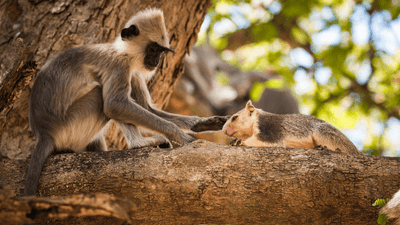
Notable interactions in their dataset included a white-cheeked gibbon holding a mouse at Shanghai Zoo. A tufted gray langur was also photographed stroking a grizzled giant squirrel. And then there were the Japanese macaques known for mounting sika deer (although that friendship can get a little weird).
The types of behaviors between primates and other species ranged from the positive, including grooming, playing, and carrying, to the abusive and sometimes fatal (RIP, one cat, two pangolins, and seven birds). Still, it shows we’re not all that unique in straying out of our lane.
“Humans have long been considered unique in forming close social relationships with other species,” said lead author Associate Professor Cyril Grueter, School of Anthropology and Museum Ethnography, University of Oxford, in a release. “Our study shows that many primates also display remarkable curiosity, tolerance and even caregiving towards animals that are not their own species.”
The results showed that the most common cross-species interactions were with other primates of the same family. This, the researchers say, makes sense given they’re more likely to share communicative signals and behavioral repertoires, meaning you’re less likely to accidentally tick the other species off (as this gosling had to learn the hard way with its adoptive eagle mother).
The answer to question one, it would appear, is yes.
Be my baby
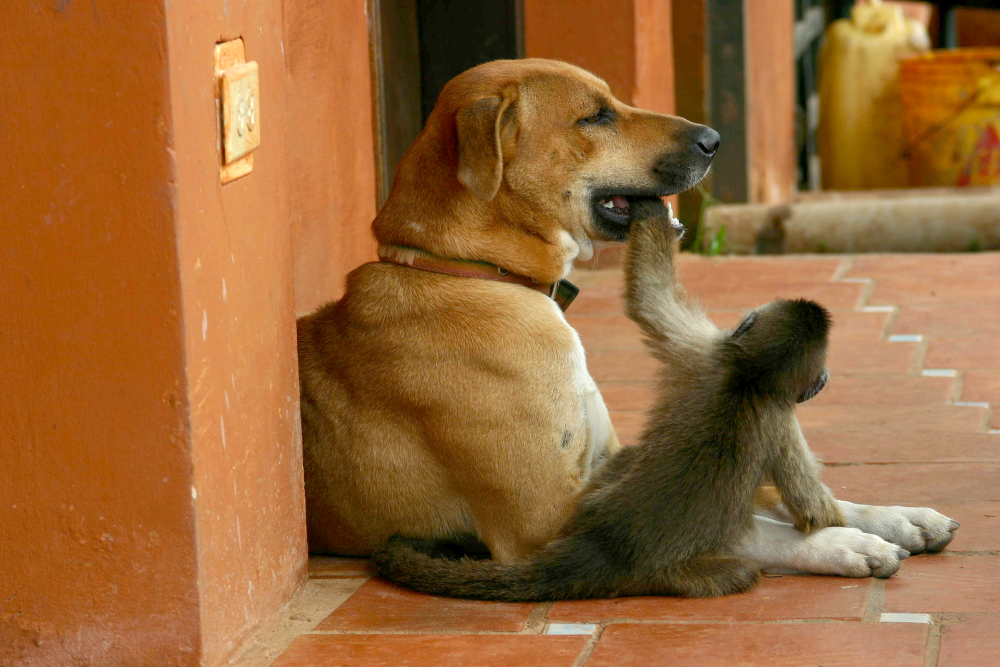
The issue of sex was also found to be significant, as the results showed females were more likely than males to engage in grooming behavior with other animals. Curiously, they didn’t show a preference for age. And whoever said a dog the equivalent age of 65 couldn’t be your baby?
Just how far this can stretch was demonstrated in a remarkable 2020 paper in Ecosphere that documented the first known example of cross-species adoption between two animals that are in direct competition with each other. Charming photos showed the unlikely trio of an Asiatic lioness with her two cubs, and a third leopard cub.
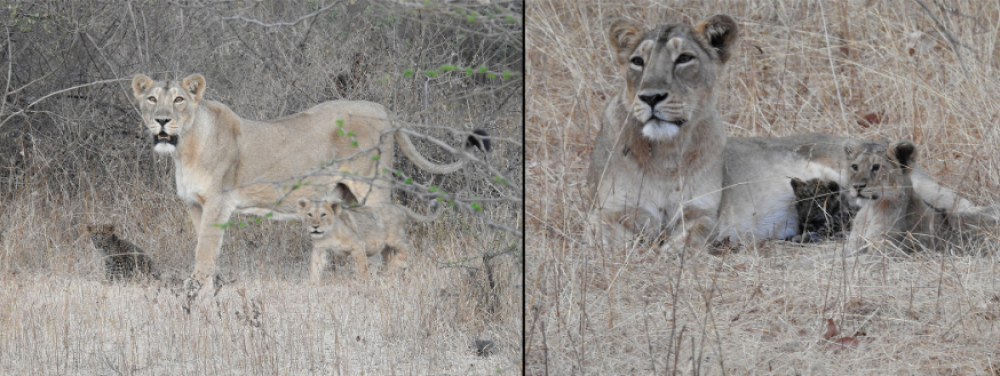
The authors likened the adoption to brood parasitism, which is facilitated by birds’ evolution favoring instinctive parental care over offspring recognition (although some chicks have evolved incredible mouths to overcome this). The cost is you may accidentally raise someone else’s baby, but the benefit is that you’ll do a smashing job – biological or otherwise.
Interspecific play dates
The third question also proved to be a resounding yes, as juveniles were found to be significantly more likely to engage in play with other animals. This mimics the pattern we tend to see among individuals of the same species, who will naturally be more playful in immaturity and then drift towards affiliative behaviors like grooming as adults.
All of these behaviors – grooming, caregiving, and play – provide benefits to social species like primates. They include antipredator benefits, improved parental care, and increased foraging opportunities.
It's possible, then, those benefits aren’t specific to engaging with your own kind. Not quite the same as having pets, but a step on the way there.
“These behaviours don't amount to pet-keeping as we know it,” said Grueter, “but they may represent some of the evolutionary building blocks from which human-animal companionship eventually emerged.”
Few among us could contain an “aww” at the sight of a langur stroking a squirrel, but the findings have implications that go beyond monkey friendships.
“Understanding why some species readily form positive relationships with others could help improve the management of mixed-species groups in zoos and sanctuaries,” said Grueter.
“More broadly, these findings provide new insights into the evolution of empathy, social flexibility and the remarkable capacity of primates to engage with animals beyond their own species.”
Now if you'll excuse me, I'm off to stroke my cat.
The study is published in the journal Primates.