Nature
 PUBLISHED
 1
1


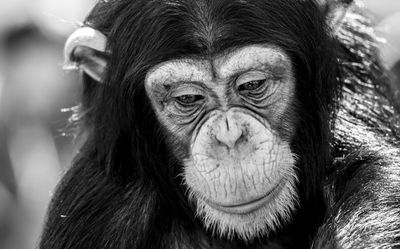


The finality of death is something that even humans struggle to come to terms with, yet certain animals demonstrate a remarkably sophisticated comprehension of this eternal journey into the void. Chimpanzees and bonobos, for instance, are regularly observed carrying the corpses of deceased infants in an apparent display of grief, although a new study questions whether this behavior reflects a genuine understanding of death.
The authors of the as yet un-peer reviewed paper analyzed 83 published cases of chimp and bonobo mothers holding on to their lost little ones for extended periods after their passing. Both belonging to the genus Pan, these two ape species are our closest living relatives, and studying their behavior therefore provides an opportunity to identify traits that are uniquely human.
According to the researchers, the ability to grasp the notion of death may indeed fall into this category, as it seems that Pan mothers carry their dead offspring out of maternal habit rather than as an act of mourning. To bolster this argument, the authors explain that the duration of infant corpse carrying (ICC) is directly correlated with age at the time of death, so that mothers hold on to their older offspring for longer than they cling to the cadavers of newborns.
This may simply reflect the strength of the bond between a mother and her young, meaning that as female chimps and bonobos get used to caring for an infant, it becomes harder for them to abandon these maternal behaviors. Such a notion is reinforced by the fact that ICC duration was also longer among Pan groups with longer gaps between births, indicating that these mothers may be predisposed to “prolonged and intensive maternal care.”
For these females, the strength of their maternal programming – rather than any inherent understanding of the nature of death – may cause them to continue mothering their deceased infants.
On top of all this, the researchers point out the ICC duration is generally longer when a young chimp or bonobo dies of disease as opposed to infanticide committed by an adult male. One explanation for this is that when death is not preceded by a violent event, mothers may not realise that their offspring has passed, thus explaining their continued caregiving.
However, in some cases, Pan mothers were observed carrying these corpses for so long that they became mummified, at which point it would be impossible not to recognize the lifelessness of their young. The study authors therefore suggest that reduced ICC following infanticide may represent a risk-reducing strategy, as adult males often kill unrelated infants in order to bring mothers back into fertility, and holding onto slain offspring may therefore incite further attacks from males as they try to force a mother to abandon her young.
“Under this interpretation, disease-related deaths are associated with longer ICC durations not because death is ambiguous, but because carrying poses fewer immediate social risks,” write the authors.
“Importantly, none of the patterns observed in ICC duration necessitate mothers recognising death as an irreversible biological state, which is a component of fully developed human death conception, though they do not preclude such recognition,” they conclude.
So while the behaviors described in this study provide no clear evidence that chimps and bonobos truly understand the ramifications of death, it’s still impossible to rule out this possibility. In fact, behaviors that could be interpreted as mourning have been observed throughout the animal kingdom, with Indian elephants known to bury the bodies of infants that pass on, while Japanese macaques sometimes groom their companions after death.
Perhaps the strongest parallel with ICC in Pan mothers comes from the ocean, where orca mothers have been documented carrying their deceased calves in a heartbreaking display of grief. Famously, a killer whale named Tahlequah was seen holding on to the corpse of her newborn for 17 days straight back in 2018, only to repeat this behavior following the loss of a second calf in early 2025.
Despite these numerous moving examples, however, the authors of the new study ultimately conclude that “the complex cognitive frameworks required to recognise death’s finality likely emerged in the hominin lineage after divergence from the Pan-Homo last common ancestor,” and is therefore particular to humanity.
A preprint of the study is currently available on bioRxiv.