Nature
 PUBLISHED




What you’ll discover in this article
- A new genus belonging to the Syngnathidae family has been discovered from museum specimens.
- The common name for this new genus is the sea Muppets.
- No one has ever seen any of these species alive.
- “I decided to CT scan H. minotaur, and the results blew me away. That was the eureka moment: a completely different skeletal structure,” study first author Graham Short told IFLScience.
Surprising things can lurk in museum drawers. In a literal case of mistaken identity, a curious set of museum specimens has led to the discovery of a whole new genus for the Syngnathidae family tree. And they're named after the Muppets.
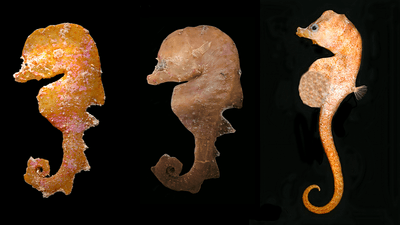
Despite its rather seahorse-like appearance, the newly named helmethead sea Muppet (Australyichthys aegis) is not a actually a species of seahorse. It was found after a dredge off the coast of the Gambier Islands in 2006, near South Australia. After it was found it sat in the invertebrate collection of the South Australian Museum, in the wrong place, for many years.
“Once you've seen the head, huge and domed with those fleshy lobes running down the back, you can't unsee the Muppet Show. It stuck straight away. The species names follow from it: bullneck sea Muppet for A. minotaur, paradoxical sea Muppet for A. paradoxus, helmethead sea Muppet for A. aegis,” first author Graham Short told IFLScience.
.png "A museum specimen of Australyichthys aegis showing two animals one with bright orange coloring and one much paler.")
Initially, two of the species were given names in the Hippocampus genus, however, the team can be forgiven for not knowing what they were looking at since only eight specimens of these mysterious sea Muppets exist in the world.
Even more surprising is that they span around 2,500 kilometers (1,550 miles) of coastline distribution, and have only been sporadically found over the last 80 years. In fact, no new specimens of muppets have been discovered or reported since 2006.
That was the eureka moment: a completely different skeletal structure.
Graham Short
“Ralph Foster, Fish Curator at the South Australian Museum, had described Hippocampus paradoxus with Martin Gomon in 2010 from a specimen in the [museum archives] collection, and both of us had long regarded that species and H. minotaur as odd seahorses that never sat comfortably in Hippocampus,” said Short.
To work out quite what they were looking at the team decided to use CT scans to take a closer look at the structures inside the fragile fish specimens. These scans let them compare the bones of the specimens directly with the true seahorses in the Hippocampus genus.
The CT scans of Australyichthys species revealed something extraordinary. There were no bony plates across the belly, and no bony coronet on the head, defining parts of seahorse anatomy – instead, the specimens had entirely different belly bones, ones not seen in any seahorse species.
.png "Two of the new species CT scans on the left, compared to CT scans of a true seahorse on the right.")
“I decided to CT scan H. minotaur, and the results blew me away. That was the eureka moment: a completely different skeletal structure. We were also able to get a small gene fragment from the ethanol-preserved individual, which placed it among the pygmy pipehorses. We now know the new genus belongs to its own distinct lineage,” Short told IFLScience.
Of the three specimens, only one had been fixed in ethanol. This gave the researchers a crucial part of the puzzle: sea Muppet DNA. The genetic testing was able to confirm what the bones had suggested – these were definitely not seahorses, and in fact they needed their own genus altogether.
We're calling Australyichthys a lost genus, and that's meant as a target, not an obituary.
Graham Short
All of these Australyichthys species qualify as "lost species" since no one has ever seen them alive. They are known only from eight specimens found in museum drawers, all dredged or brought up by fishing trawlers from around 50 and 124 meters (164 and 406 feet) deep.
There are no photos or videos of these species in their habitat. However, the bones and CT scans of the specimens can give us some clues as to how they live and what they might eat.
“In the A. paradoxus holotype the scan showed a heavy concentration of small, dense, circular objects scattered through the trunk cavity, packed anterior to the developing oocytes and up against the visceral organs,” said Short.
“Their density matches calcified exoskeleton, so these are almost certainly the remains of crustaceans the fish had eaten. We couldn't identify them beyond that. It's the first direct evidence of diet for the genus, and it says they take small benthic or planktonic crustaceans, probably whatever comes past.”
The only way to know for sure about the species' behavior and diet is to witness it first hand, something Short thinks will be tough but not impossible. Earlier this year a species of ghost pipefish was finally confirmed after years spent trying to find the elusive Solenostomus snuffleupagus.
“We're calling Australyichthys a lost genus, and that's meant as a target, not an obituary. Eight specimens in nearly 80 years, nothing since 2006, no confirmed sighting alive. The temperate mesophotic zone off southern Australia is one of the least surveyed marine environments anywhere, so the odds are these fish are still down there and simply haven't been looked for.”
“They're also small, cryptic, and can't escape a bottom trawl, which puts them at real risk. Going and finding out is the only way to know which it is,” concluded Short.
The study is published in the Journal Of Lost Species.