Nature
 PUBLISHED
 1
1




The animal kingdom is full of spectacularly colored creatures. From bright blue tarantulas to the stripes and spots on a tiger cat, just about every kind of pattern and hue can be found somewhere. Problems arise, however, when those who admire these bright colors want a closer look. Research has revealed that a bat species in Asia is under threat due to its popularity as a decorative ornament.
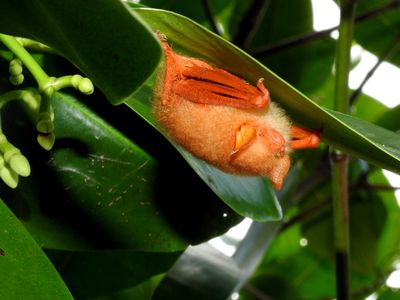
The painted wooly bat (Kerivoula picta) is a striking species with bright orange fur and patterned wings. On popular online shopping sites like Etsy and eBay, dead bats can be bought as display items with their wings outstretched. The researchers looked at 856 general bat listings and found 215 of them were for the painted wooly bats, representing 284 individual animals.

“These bats are not from the United States, but they’re being sourced from across Asia and then brought here and used as décor,” co-leading author Nistara Randhawa, a UC Davis data scientist and epidemiologist, said in a statement. “With this study, we hope to raise awareness and propel the conservation of this species.”
What makes the bats especially vulnerable to this kind of human actively is their slow life history. The adults live around 10 years and produce just one offspring at a time. In the wild they are found across Asia, where their bright orange fur acts as camouflage against the dried leaves where they roost. The IUCN Red List has them under the Near Threatened bracket but suggests there have been insufficient surveys.
The team also explored the influence of Halloween on the bat sales. They found that Tennessee sold more bats than any other state between the 2022 Halloween and Christmas periods. Around 20 percent of the sales listings used words such as “ethical” or “sustainable” with some sellers even claiming the bats had been bred in captivity and died under normal circumstances – all claims that the authors strongly suspect to be false.
“We’re talking about 284 distinct individuals found over just a three-month period,” said co-leading author Joanna Coleman, an assistant professor at CUNY-Queens College and co-chair of the IUCN’s Bat Trade Working Group. “That doesn’t include all the others sold on websites and physical shops year-round across the world. Because these bats are quite scarce on landscapes, we are concerned that hunters might be systematically going out and removing every individual they see.”
The authors suggest that the painted wooly bat be included under the Convention on International Trade in Endangered Species of Wild Fauna and Flora (CITES), which would prohibit any international trade. They further suggest more fieldwork studies to better understand the population remaining in the wild.
"Bat populations are declining worldwide, and K. picta is but one of the many unique bat species affected by ongoing global biodiversity loss,” Randhawa said. “They are incredibly important to protect, not least because of the vital ecosystem services bats provide. K. picta should be roosting under the banana leaves of its natural habitat, not hanging dead on a wall as décor.”
The study is published in The European Journal of Wildlife Research.