Nature
 PUBLISHED
 1
1


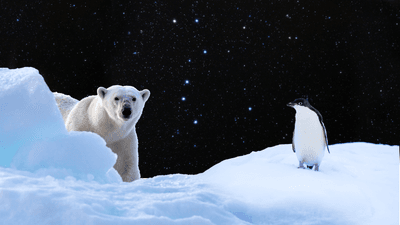


Visit the Antarctic and you’ll find penguins. Lots of penguins. Chubby, slow (on land, at least), feathery penguins. And do you know why? Because it’s a bear-free zone.
Polar bears are found at the Earth’s opposite pole in the Arctic, much to the delight of the penguins down south. So, you probably won’t be very impressed to learn that the word Arctic was inspired by the Greek arktikós, meaning "related to/near the bear". You also probably won’t be impressed to learn that the word Antarctic means “opposite of bear” (where anti = opposite). But what might surprise you is the fact that all of this etymology has absolutely nothing to do with polar bears.
Yes, it seems the names Arctic and Antarctic correctly identifying where you will and won’t find bears is something of a happy accident. In fact, the name is thought to have come about before humans started exploring the Antarctic continent in a big way, and therefore before they had any grasp of the region’s bear status.
So, what on Earth did inspire the name of the Arctic and Antarctic? Nothing, really, because for that etymological origin story we have to visit the stars.
It all boils down to the Northern Hemisphere’s most famous constellation: Ursa Major (which is Latin for “the Great Bear”). There’s no trick here – it’s known as the Great Bear because it looks like big bear.
Ursa Major is visible year-round, but your best chance of spotting it is in April. It’s featured in a rich variety of human cultures throughout history, and as a circumpolar constellation that’s located around the North Celestial Pole, its shape inspired the name given to the Arctic. There's also Ursa Minor, a smaller constellation known as "the Little Bear".
The zoologically inclined among you may also remember that Ursus is the genus name for bears, and this time the bears got there before the constellation. It was with great pride that Space & Physics Editor Dr Alfredo Carpineti reported that this means the brown bear, Ursus arctos, is a satisfying mashup of Latin and Greek, delivering the excellent scientific name: Bear bear.
So, was the Antarctic named anti-arktikós because it’s the bear-less pole opposite the pole with polar bears? No, but did it accidentally become a great way to remember which end of the planet is home to polar bears? Yes.
That is, until they find out about all the delicious penguins…