Nature
 PUBLISHED


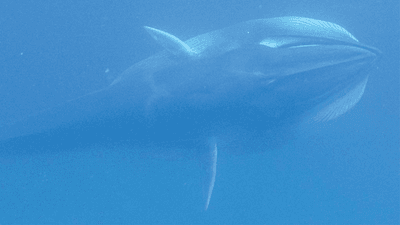


It might strike you as surprising that there are still large species we know relatively little about. The Omura's whale (Balaenoptera omurai) is one of those species. Scientists only discovered the animal in 2003 and since then very little has been learned about its behavior and ecology. What we do know has come from stranded or washed-up specimens, and now there’s another one.
Off the coast of Singapore at the Tanjong Pagar Terminal, a carcass in an advanced stage of decomposition was recorded. The team noted that the specimen was not entire and that most of the skin had “sloughed off”, and the specimen seemed to be about 4.8 meters (15.7 feet) in length.
On September 12, 2025, the carcass was taken to the Lee Kong Chian Natural History Museum to be further investigated. Based on DNA taken from the carcass the team found that the specimen was a male Omura’s whale. This combined with features of the skull that are unique to Omura’s whales made the team confident in their findings.
The specimen represents the first recorded stranding of an Omura’s whale in Singapore and the first whale stranding of any species in 10 years. The investigations into the body of the whale show that there is damage to the skeleton, suggesting ship strike injuries might have been responsible for the whale’s death.
Looking at the skull and spine bones, the team saw that some of the bones remain unfused, suggesting that this was a subadult. However, the length of the total whale was predicted at around 10.6 meters long (34.7 feet) and most whales are said to reach around 9 meters (29.5 feet) when mature.
Recent research showed that the global distribution of Omura’s whales is much larger than once thought. In a 2015 paper, researchers were able to describe more than 40 sightings of these elusive whales over a three-year time period. Fortunately, they were also able to record video footage of the whales for the first time.
This led to even more sightings and a global distribution began to emerge. Interestingly, the whales seem to prefer coastal waters, which makes it even more impressive that they remained undiscovered for so long. Early whalers thought they must be a smaller or pygmy version of the Bryde’s whale.
Despite their global distribution, it is thought that these populations could be quite isolated without much travel between groups. They may also be loyal to certain areas; one population off the coast of Madagascar can now be seen all year round. The whales are most often seen alone or in pairs, though will sometimes gather around larger groups of prey, such as krill or small fish, that they filter from the water.
The study is published in Nature in Singapore.

 1
1