Nature
 PUBLISHED


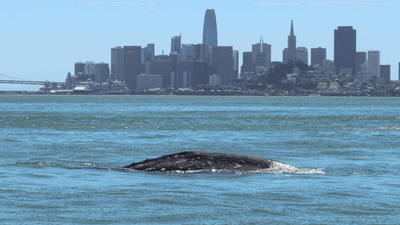


Humans no longer hunt gray whales, and whale watching tours rely on their presence, but we still pose a major threat to their survival. A new study has revealed that two consequences of human activity are combining to endanger the great whales that come into San Francisco Bay to feed. The findings may help explain why this species has not followed the recovery path of humpback whales since widespread whaling stopped.
Like the other great whales, gray whales (Eschrichtius robustus) make epic migrations from the polar waters where they feed to breed in the tropics. In the case of the largest gray whale population, this takes them from Northern Alaska to Mexico. In recent years many have been stopping in San Francisco Bay.
Unfortunately, a bay with such a big human population around it is filled with ships, and when metal and flesh meet, the whales don’t come out of it well. “Gray whales have a low profile to the water when they surface, and this makes them difficult to see in conditions like fog which are common to San Francisco Bay,” said lead author Josephine Slaathaug of Sonoma State University in a statement. “Additionally, San Francisco Bay is a highly trafficked waterway, and the Golden Gate Strait serves as a bottleneck through which all traffic and whales must enter and exit.”
.png "Unfortunately even such a giant whale tail can be hard to spot, particularly when conditions are bad")
Consequently, Slaathaug and co-authors have found, at least 18 percent of the gray whales that enter San Francisco Bay die there, and the figure may be much higher.
Before 2018, gray whales were seldom reported in San Francisco Bay. Perhaps the aforementioned fog caused people to overlook their presence, but when food was plentiful in the Arctic, a San Francisco vacation would have merely delayed their arrival at tropical breeding grounds. It is thought the increasing number of whales entering the Bay is because many whales now lack the fat reserves to make it to Baja California and back to the Arctic without finding food on the way.
The poorer feeding seasons, in turn, are thought likely to be a consequence of climate change.
Between the loss of food stocks and the hazards of the journey, the Eastern North Pacific gray whale population has fallen a precipitous 50 percent since 2016, with few calves spotted. Although a few gray whales were recently sighted in the Atlantic for the first time in centuries, the species’ “Least Concern” status on the IUCN Red List must now be in serious doubt.
With help from citizen scientists, Slaathaug and colleagues identified 114 whales that entered San Francisco Bay between 2018 and 2025 by their markings. Thirty-six of these were seen in 2025 alone. Identifying features were compared with the 70 whales whose carcasses were found in the local area. Some of the dead whales were too badly decomposed for identification, but 21 could be matched to those that had been seen alive. Many more deaths have been reported in the surrounding regions over the same period.
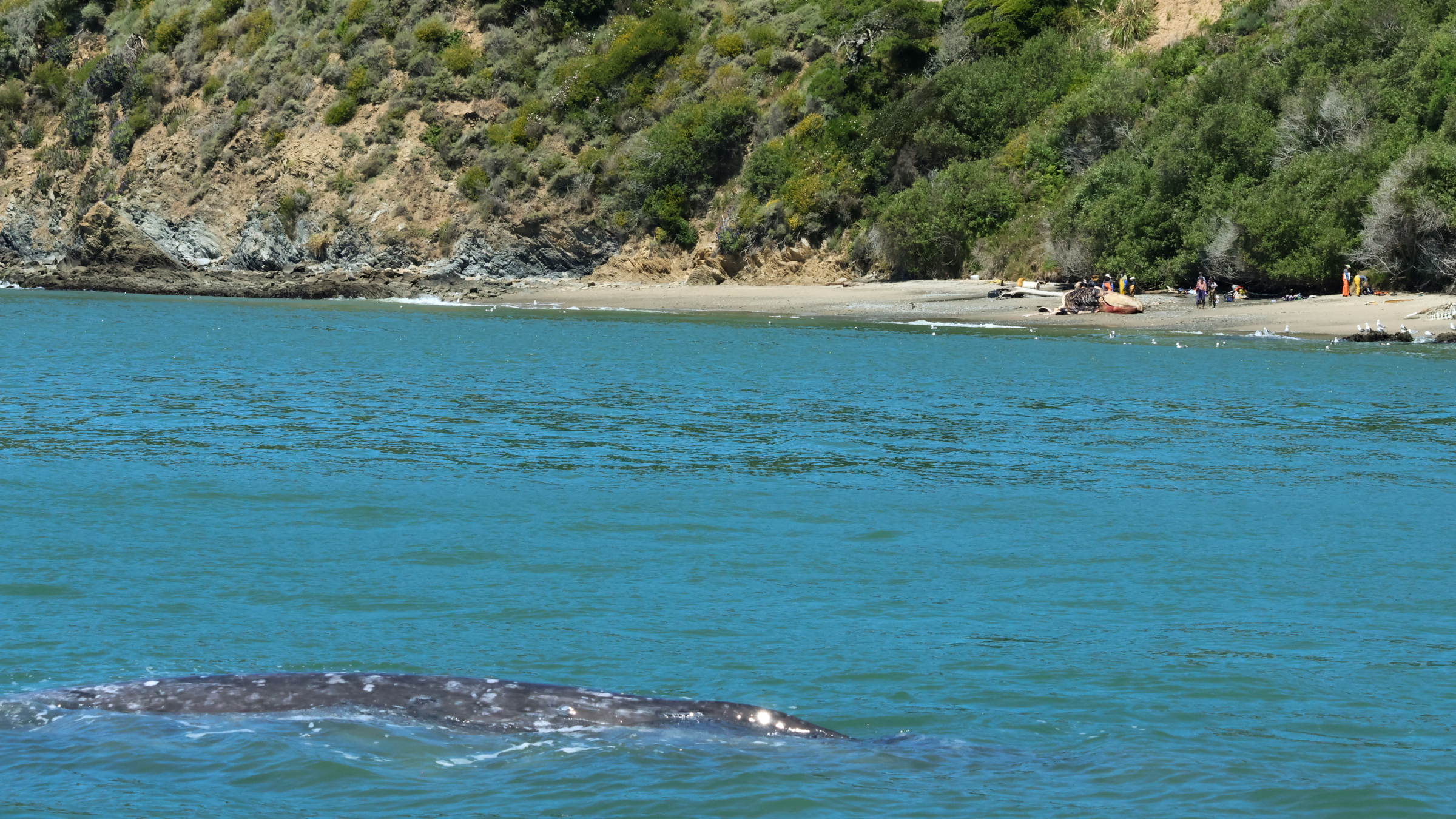
“At least 18% of the individuals identified in San Francisco Bay later died in the area,” said co-author Bekah Lane of the Center for Coastal Studies. “Our broader analysis of local strandings both inside and outside San Francisco Bay found that over 40% of these whales died of trauma from vessels.” Some of the other deaths have been attributed to malnutrition, but for many the cause is unknown. San Francisco Bay may still have plenty to offer smaller marine mammals in terms of food, but it has little of what a gray whale needs.
The authors hope their work can reduce the ship strikes. Fortunately, those whales that survive their side quest seem to learn the Bay is not a safe place to visit, with only four being sighted in multiple years. However, if most whales making the journey are starving, helping them leave safely will count for little in the long run.
Some gray whales have managed to adapt their diet, foraging for ghost shrimp and herring roe near Seattle, but it’s unlikely California will offer them an equally productive way station.
The study is published in Frontiers in Marine Science.