Nature
 PUBLISHED




As bodies of water go, the ocean is pretty flippin’ huge. With all that wet real estate up for grabs, you might think boats and whales living in blissful isolation from one another would be easy – but recent reports have served as a sobering reminder that this is not the case. In February, some anxiety-inducing data on the movements of one blue whale over a week emerged, showing the unending back and forth in the waters off Patagonia as it tried to avoid ships. This didn't include recreational vessels either, just heavy shipping traffic.
Blue whales can be unpredictable, spending a lot of time deep in the ocean before darting to the surface for feeding. This lifestyle puts them at risk from large vessels with heavy-duty propellers, who may not see the whale until it’s too late. Vessel strikes can cause devastating injuries to whales and it’s not uncommon for these to prove fatal. Research, published in the journal Nature, highlights the need to establish where movement corridors are for these animals so that conservation efforts can work with shipping traffic to avoid fatal collisions.
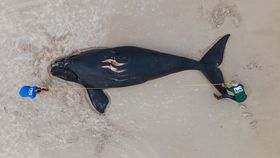
Images published on Facebook by the Florida Fish and Wildlife Conservation Commission Fish and Wildlife Research Institute (FWC FWRI) show the tragic outcome of a 54-foot sportfishing vessel that collided with a Right whale. “On the evening of February 12, 2021, a 54-foot sportfishing vessel captain reported hitting a whale near the entrance to St. Augustine Inlet,” read the post. “The vessel began taking on water and was quickly grounded to prevent it from sinking. The occupants are all safe. The Captain’s near real-time report is vital to increasing our understanding of vessel strike events and alerted researchers to be on the lookout for an injured or dead whale.”
The search ended with the discovery of a North Atlantic Right whale calf the following morning on a beach in Anastasia State Park. The calf was just one month old, and was the offspring of a whale known to the FWC FWRI as Catalog #3230 ‘Infinity’. Mom and calf had been swimming in the local waters which are calving grounds for North Atlantic right whales, with two other mother-calf pairs also spotted in January 2021.
A necropsy revealed the 22-foot-long male calf had sustained cuts to its back and head from the boat’s propeller, as well as broken ribs and bruising that was likely caused by the impact of the sportfishing vessel. Mother Infinity was later spotted on February 16 alive, but with injuries consistent with vessel strike, which also appeared to have been caused by the boat’s propeller. She will continue to be monitored while members of the FWC FWRI try to assess the severity of Infinity’s wounds.

Care for these animals poses a complex problem, as injuries aren't always obvious, and while superficial cuts can look to be initially benign, in time they can develop fatal infections. Stories like these highlight the need for more research into migration routes for surface-dwelling whales, so that scientists can work with vessel traffic services to better direct boats and avoid such accidents. For now, the onus for protecting these animals is on the shoulders of captains, who – as a spokesperson from global marine charity Whale and Dolphin Conservation (WDC) told IFLScience in an email – can take steps to reduce the risk of collisions.
"[Advice] for captains is fairly simple and life saving – slow down and post a look out," said the WDC. "The ideal speed to slow down to is 10 knots which increases your time to see a whale and gives the whale some additional time to react. If a collision does occur, it’s less likely to be fatal. Small vessels hitting a whale risk vessel damage and passenger injuries so it’s not only about saving whales."