Nature
 PUBLISHED
 2
2


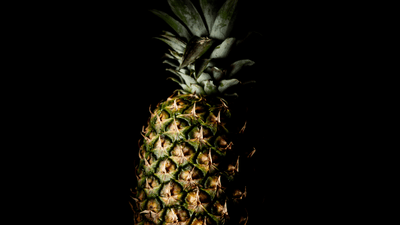


If something came over you and you felt compelled to drop a metal ball superheated to 1,000 degrees Celsius (1,832 degrees Fahrenheit) onto a piece of pineapple skin, you'd observe a peculiar phenomenon. Rather than burning, erupting into flames, or fizzing out of existence, the pineapple skin does, well, not much. How? It all comes down to a little something called the Leidenfrost effect.
Such a bizarre experiment was shared in a video on X. In it, we see a defenceless sliver of pineapple skin on a table, minding its own business until a super-heated glowing iron ball is dropped on top of it.
The video rolls on and the pineapple skin looks pretty much fine until eventually the ball loses its orange glow. Flipping it over reveals that the fleshy innards never even got singed, so what’s going on? Is pineapple some kind of super material we should be crafting into armor?
As much as we’d love to see that battle, the fact is that what we’re witnessing here is a nifty quirk of heat transfer. It’s something called the Leidenfrost effect and it isn’t unique to pineapples (see also: watermelons). It's a fun phenomenon that can make water flow uphill, and you’ve probably seen it in the kitchen.

As explained by Seppo Louhenkilpi from the Aalto University School of Chemical Technology, heat transfer is influenced by something known as Leidenfrost temperature. Above this temperature, a surface is so hot that when it comes into contact with a liquid it forms a layer of steam so the surface and the liquid aren’t in direct contact.
Where you may have seen this before is if you drop liquid on a hot surface, it can form into little balls that appear to float. Similarly, if you put a really hot ball in water, it creates a little steam bubble so that the ball itself isn’t touching the water. Just check it out in the below video.
What this means for heat transfer is that on surfaces above the Leidenfrost temperature, the heat transfer rate doesn’t change much. For surfaces below the Leidenfrost temperature, the comparatively cooler hot surface can come into direct contact with the liquid, increasing the rate of heat transfer significantly.
So, bizarrely, you could do more damage to a pineapple with a moderately heated ball than a superheated one. Something to remember should you find yourself facing an army of people who didn’t know about the Leidenfrost effect and took this video to mean that pineapple armor was a good idea.