Nature
 PUBLISHED
 1
1



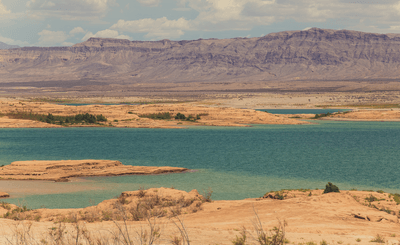


Lake Mead, the largest reservoir in the US, has been struggling for decades, but this summer it's taken its heaviest blow yet.
Water levels at the reservoir have dwindled to just 317.09 meters (1,040.3 feet) above sea level on Saturday, August 8, following a steady decline since the start of the year, according to federal data from the US Bureau of Reclamation.
The last time Lake Mead reached full capacity was in 1983, when water levels peaked at 373.5 meters (1225.44 feet). Over the following 40 years, water levels have continued to wane in a downward trajectory.
The current level reached last weekend is now below the previous record seen in 2022, when the lake became so parched that it revealed several human bodies.
An unnatural lake
Lake Mead is a 40-minute drive, or around 39 kilometers (24 miles), from the flashing lights of Las Vegas. In the desert terrain straddling Nevada and Arizona, it acts as a brief stopover for the Colorado River.
If this seems like an unusual place for a body of water, you'd be correct.
It was created in the 1930s, after the completion of the Hoover Dam flooded the barren land, and allowing humans to manage the flow of the Colorado River to supply water and hydroelectric power to parts of the southwestern US.
Even today, Lake Mead supplies water to some 40 million people across Arizona, Nevada, California, and parts of Mexico. All of this means its recent decline is very unwelcome news, even beyond the strain it will put on the range of desert and aquatic wildlife that inhabit the region.
Why Lake Mead is drying out
The declining fortunes of Lake Mead are due to water usage, climate change, and a long-term drought.
Spurred on by the global climate crisis, the southwestern US is currently experiencing the worst drought in 1,200 years. Higher temperatures are leading to more evaporation, while changes in rainfall mean the lake is not being refilled as regularly as before.
Increasing demand, both from growing populations and thirsty agriculture, is another primary cause of the issue. As one of the more immediately solvable challenges, authorities have been attempting to remedy the problem over recent years, but solutions have not come easily.
No end in sight for the Colorado River Basin
States within the Colorado River Basin that rely on the water — California, Colorado, Arizona, Nevada, New Mexico, Wyoming, and Utah – have continually failed to reach an agreement on how to divvy up this dwindling resource.
The water-sharing agreements expired in 2026 with no replacement deal in place, and the seven states are split into an upper basin (Colorado, New Mexico, Utah, Wyoming) and lower basin (Arizona, California, Nevada) that remain at a standstill.
On July 31, 2026, federal officials announced they had completed a framework for Colorado River operations for the next 10 years, but acknowledged this was a temporary band-aid, rather than an all-encompassing solution to a deeply fiddly problem.
“This is an important milestone, but it is not the finish line,” JB Hamby, Chairman of the Colorado River Board of California and Colorado River Commissioner for California, said in a statement. “The framework establishes sideboards on operations for the next ten years.”
“The proposal responds to a fundamental reality: the Colorado River no longer reliably produces enough water to support all the uses and expectations built around it. That challenge is shared across the Basin, and addressing it requires specific, measurable reductions in water use by every state,” he added.