Nature
 PUBLISHED


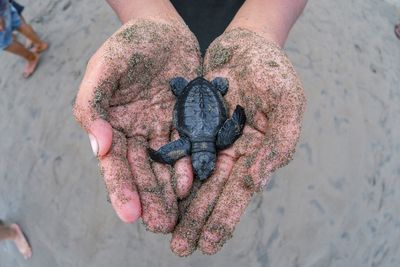


It might sound like a dream scenario: crystal clear water, soft sand, sunset dipping beyond the waves... but what happens when you find a baby turtle on your romantic vacation stroll? We break down the dos and don’ts of helping these animals.
Rule 1
Rule number one is that the animal might not even need your help and the best thing to do is to leave it alone. Baby turtles, while small, are actually surprisingly self sufficient and typically get no parental help. Instead they are able to find food, swim, and hide from predators almost immediately upon hatching.
Adult turtles typically come back to the same area of beach they hatched from in a behavior called natal homing. Extensive conservation efforts have gone into protecting certain areas from human interference and artificial lights, which can confuse baby turtles.
However, a review from 2025 showed that most sea turtle populations are rebounding worldwide, in part thanks to measures adopted by fishing agencies to reduce turtles as bycatch.
“Sea turtles are a shining light of marine conservation with recoveries of many nesting populations,” Graeme Hays, Distinguished Professor and Chair in Marine Science at Deakin University in Australia and study author, told the National Oceanic and Atmospheric Administration (NOAA).
Rule 2
Most baby turtles will head to the nearest body of water. If you think there’s something dangerous in the way, such as a road crossing or predators, the Toronto Wildlife Centre suggests gently picking them up and moving them closer to the river or the sea.
“Don’t put it directly in the water – place it on the bank a foot or two away, and watch to see that everything goes smoothly,” they advise.
Rule 3
Another rule is to make sure what you are looking at is actually a turtle and not a tortoise. Most tortoises are escaped pets, while some roam across the drier states.
If you find a water turtle that is actively bleeding or injured, the Houston Humane Society recommends wearing gloves to handle the animal and putting it inside a cardboard box with a towel at the bottom and taking it to your nearest shelter, or calling Animal Help Now for advice and assistance.
If you are worried the turtle might be injured, check for cracks along its shell or any wounds. If you accidentally uncover a turtle egg clutch, gently rebury them in the same orientation if possible and contact a wildlife rehabilitator for guidance.
Cold-stunned adult turtles are a different matter and are frequently rescued by centers and biologists, who warm them up and take care of them before they can be released back into the sea.
One special turtle among those rescued recently was Earl Grey, who turned out to be the living product of a female Kemp’s ridley sea turtle (Lepidochelys kempii) mating with a male loggerhead sea turtle (Caretta caretta).
"Each year, the Georgia Sea Turtle Center receives a number of cold-stunned sea turtle patients that have stranded in Cape Cod, Massachusetts. Since we receive so many in a short period, the Center staff chooses a naming theme for the group," Lauren Buie, Marketing Communications Manager at the Jekyll Island Authority, told IFLScience.
"This year's was tea, so along with Earl Grey, we had Boba, Matcha, Oolong, Darjeeling, and many more with similar names!"
The golden rule is usually if the animal is not obviously hurt or in immediate danger just leave it well alone. This applies to baby birds and deer fawns too. Often even the most well-intentioned human helper can do more harm than good by interfering with a young animal. Nature has got this one, so take a step back.