Nature
 PUBLISHED
 1
1


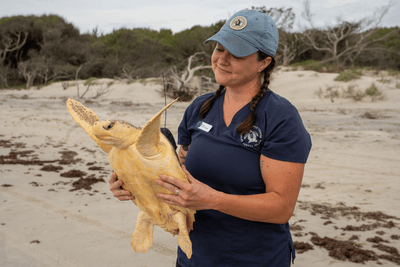


In the winter just gone, before springtime had warmed the East Coast's waters, a cold-stunned turtle was found floating along the shores of New England. Upon closer inspection, a team of experts made a surprising discovery: the frigid individual was a hybrid of two distinct sea turtle species.
His name is Earl Grey, the living product of a female Kemp’s ridley sea turtle (Lepidochelys kempii) mating with a male loggerhead sea turtle (Caretta caretta).
Earl Grey's mistaken identity
He was recovered from the coastline off Massachusetts by NOAA biologists who assumed it was a loggerhead that had been mixed up with a handful of cold-stunned Kemp’s ridley sea turtles. Along with eight other turtles, he was packed into a banana box lined with beach towels and flown over 1,600 kilometers (1,000 miles) from Boston down to Jekyll Island, where the Georgia Sea Turtle Center is stationed.
"Each year, the Georgia Sea Turtle Center receives a number of cold-stunned sea turtle patients that have stranded in Cape Cod, Massachusetts. Since we receive so many in a short period, the Center staff chooses a naming theme for the group," Lauren Buie, Marketing Communications Manager at the Jekyll Island Authority, told IFLScience.
"This year's was tea, so along with Earl Grey, we had Boba, Matcha, Oolong, Darjeeling, and many more with similar names!"
It was only here that vets realized this was no ordinary loggerhead. As a hybrid, Earl Grey has traits from both parent species: the hooked beak and the round shell of the Kemp’s ridley sea turtle, but the paler coloration and five back spikes of the loggerhead. He’s also much smaller than the average loggerhead.
The team managed to get a blood sample from the individual and passed it on to experts at the University of Georgia for genetic testing. Just as they suspected, Earl Grey was a first‑generation hybrid.
"Earl Grey is the first confirmed hybrid in our care. One of the challenges is that genetic testing is not routinely performed on every sea turtle patient at every facility. So, in many cases, many may go undiscovered," explained Buie.
"We do our genetic testing in partnership with the University of Georgia, and we absolutely encourage other facilities and researchers to pursue genetic testing as well. It is the best way for us to gather more information about hybrids, better understand how frequently hybridization occurs, and learn what it may mean for sea turtle conservation in the future."
Just seven species of sea turtle
There are just seven species of sea turtles globally, and all but one (the flatback sea turtle) are found in US waters. As they cruise the same waters, different species do intermingle, and hybridization is known to occur. Along some parts of the Brazilian coast, hybrids make up 32 to 42 percent of the sea turtle population. Elsewhere, it’s a much rarer occurrence, but it still happens.
What makes Earl Grey especially rare is his maternal lineage, the Kemp’s ridley sea turtle, which is the smallest and most critically endangered sea turtle species. Primarily found in the Gulf of America, up to 95 percent of their nesting occurs in the state of Tamaulipas, Mexico. A small number of nesting grounds are found elsewhere along Mexican beaches, as well as parts of North Carolina, South Carolina, Georgia, Florida, and Alabama.
Earl Grey's return to the sea
All’s well that ends well. Earl Grey was released back into the Atlantic Ocean in a quiet ceremony on May 28. His shell was fitted with a satellite tracking device before he departed, giving his rescuers a way to follow his progress and wish him well from afar.
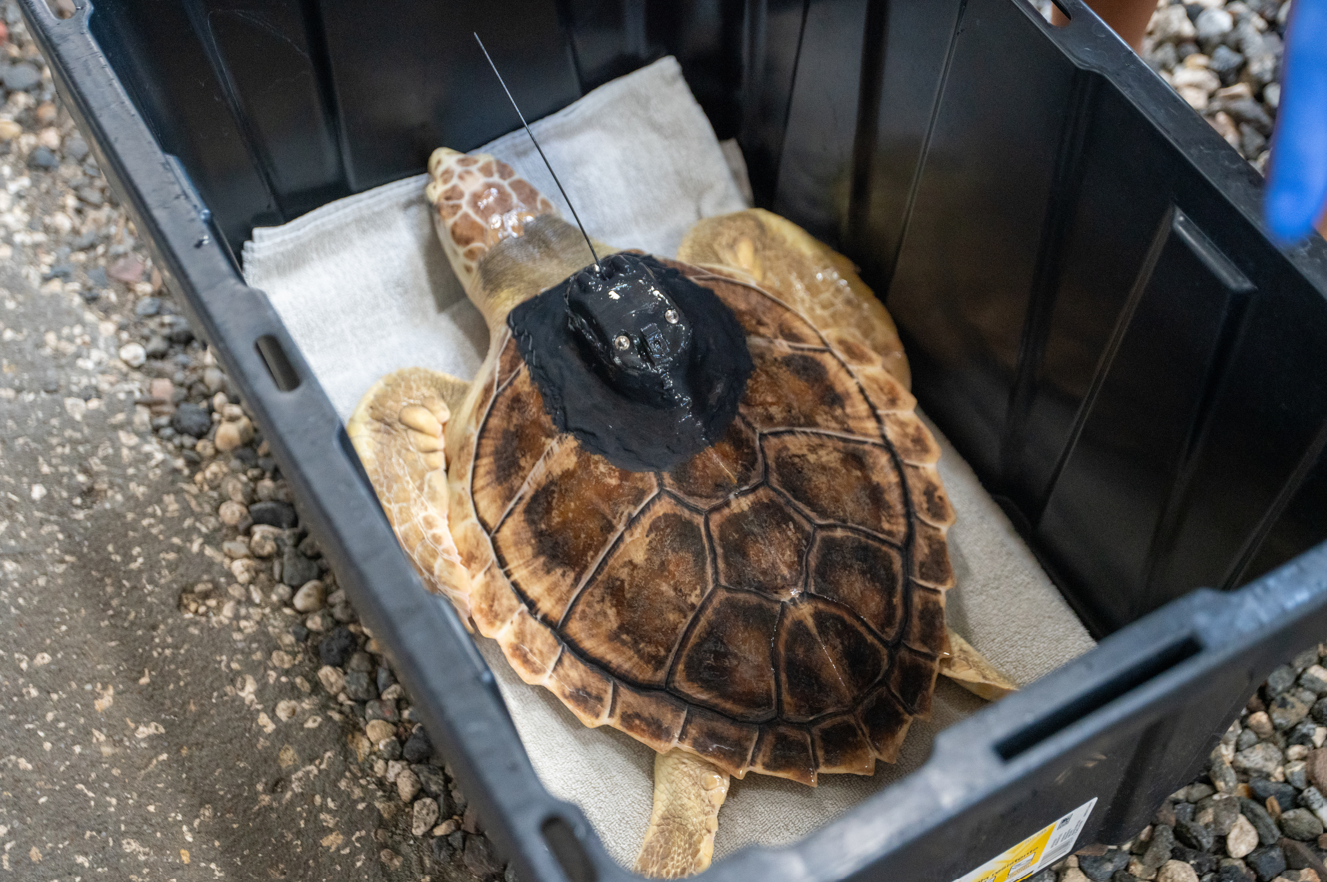
All of the data will feed into a broader conservation effort supported by the US Navy's Marine Species Monitoring Program, in collaboration with the University of Central Florida Marine Turtle Research Group, aimed at documenting and protecting sea turtle populations.
"Scientists currently use aerial surveys to estimate sea turtle populations, but because turtles spend much of their time underwater, they can be difficult to spot from the air. The tracking data helps researchers better understand how often turtles surface, leading to more accurate population estimates, stronger conservation planning, and improved protection for vulnerable marine species," concluded Buie.
Godspeed, Earl Grey, and good luck.