Nature
 PUBLISHED


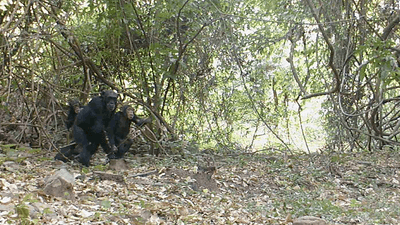


Chimps are the poster children for tool use in animals after their remarkable behavior was first recorded by the late, great Jane Goodall. However, how the knowledge of which tools to use in which situations gets communicated between mother and infant is something researchers are keen to learn more about.
To do this a team analyzed heaps of footage of chimpanzees (Pan troglodytes verus) taken from camera traps at 14 sites where the chimps were known to use tools, all set up in the Dindefelo savannah in Senegal.
“In addition to passing tools for fishing algae, extracting ants and catching termites among themselves, chimpanzees also share baobab tree fruits, which they crack open by striking them against stone or wooden anvils,” explained Andreu Sánchez-Megías, first author of the article and a researcher at the University of Barcelona, in a statement.
“This transfer of tools and fruits represents a form of teaching that mothers seem to use to help their offspring learn these tool-use behaviours.”
The footage shows adult wild chimpanzees teaching their offspring how to handle tools and find food. This is critical for the next generation of chimpanzees to learn how to forage and be successful.
The camera traps recorded almost 15 hours of footage with 33 instances where tool transfer occurred; 19 of these involved dipping for ants, while 10 were for algae, and there were four occasions where the chimps were feeding on termites.
In total, the team saw 33 tool transfers and four fruit transfers between the chimps.
Additionally, the team have 30 minutes of footage of the chimps pounding baobab fruits to crack them open. This is known as proto-tool use, since the chimps do not modify the sharp rocks to crack the fruits.
In one case, a female adult and her daughter were ant-dipping with a group.
“The female adult moved next to the infant and inserted the tool into the ant nest. She left the tool inserted into the nest, turned around to grab the infant, and brought the infant to the tool. Then, the infant grabbed the tool, retrieved it from the ant nest, and consumed the ant,” explain the authors in the paper.
“We also describe a case in which a mother carries her offspring to a tool she has previously left in the ant nest so that the young one can pull it out covered in ants,” said Sánchez-Megías.
In another example, a younger chimp watched a subadult pound baobab fruit on a rocky platform. The infant held onto the fruit while the subadult pounded it, showing another example of this type of knowledge transfer and learning as it guided the infant's hand through the motions.
“[In this example], a young chimpanzee apparently accompanies, encourages and helps a young individual that is trying to crack open a hard baobab fruit by striking it against a rocky surface,” said Sánchez-Megías.
The team thinks these instances align with the definition of learning, but do show some cost to the teacher in terms of giving up their feeding tool or time so the younger chimp can have a go. These opportunities represent a significant benefit to the receiver of the tool, who was found to engage in significantly more feeding behavior.
The team acknowledges the relatively small sample size and suggests a next step could be to explore whether the passing of this kind of knowledge is similar across other chimpanzee communities.
Tool use is not exclusive to chimps though. Cows do it (remember Veronika?), wolves might do it, and even dolphins have been recorded teaching each other how to catch fish with shells.
The study is published in Frontiers in Psychology.