Nature
 PUBLISHED
 1
1


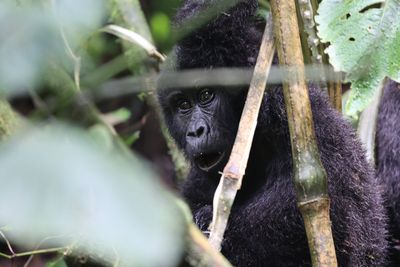


Interactions between different wild species can take many forms. There are intense predator-prey relationships, interspecies adoptions (that do not always end well), and in some animals, like monkeys, interactions that blur the lines between friendships and taking a step towards keeping pets. For a group of young gorillas, however, they’ve just come to learn what a chameleon is.
Recorded by the Dian Fossey Gorilla Fund, these youngsters from the Kwitonda group of Rwanda's Volcanoes National Park are fascinated by a tiny chameleon moving through the undergrowth.
Five gorillas can be seen huddled around some foliage that at first doesn't appear to be doing anything interesting. Helpfully for the viewer, one gorilla points to the chameleon, whether to gently touch it or make it move to encourage it out to the open, we don't know.
Once the chameleon is out in the open, the same gorilla reaches out a couple of times but doesn't touch it. In fact, all the youngsters crowded around the tiny lizard follow its progress but don't get too close.
"The poor chameleon probably felt terrified, but the gorillas were incredibly gentle and simply curious," the Dian Fossey Gorilla Fund said under the video. "They watched it closely without harming it, and eventually it wandered away safe and sound."
It's not the first time that gorillas have been documented having a curious interaction with a chameleon, though.
Earlier this year, the Dian Fossey Gorilla Fund shared a video of the Kwisanga group also in Volcanoes National Park. An adult gorilla is unaware of (or doesn't care about) a tiny visitor climbing on its head, but a young gorilla is determined to get a better look at this unexpected company.
Gorilla families
The Kwitonda gorilla group family is one set of mountain gorillas living in Volcanoes National Park in Rwanda. Before moving to Rwanda, the group lived in the Virunga National Park in the Democratic Republic of Congo but is thought to have moved due to pressure from other nearby gorilla families.
Now they are thought to reside between Mount Karisimbi and Mount Muhabura. The group is named for the silverback that established the Kwitonda family and led them to Rwanda. Sadly, he passed away in 2012, but the group continues to thrive.
Earlier this year, Netflix released A Gorilla Story: Told By David Attenborough, starring the antics of another family in the Virunga Mountains, the Pablo group. The film uses almost six decades of research by Dian Fossey, who founded the Dian Fossey Gorilla Fund, and others like her to show the audience an intimate portrayal of gorilla family life in these mountains.
"We really felt that Pablo's group was a story that needed to be told," Dr Tara Stoinski, scientific advisor to the crew and President, CEO, and Chief Scientific Officer of the Dian Fossey Gorilla Fund, told IFLScience.
"This is an amazing family that's been around for more than 30 years that we've been studying every day."
Can animals have pets?
While this chameleon walked away from its encounter with the gorillas, it raises the question of whether animals could keep another species as a pet. We know that animals can certainly have friends outside of their immediate family; this might even be true of your pet dog. But could one species keep another as a pet?
There’s been some pretty interesting examples of other species getting adopted into different species groups: a group of black-striped capuchins in Brazil took in an infant marmoset, a leopard cub was adopted by a lion mum, and a female dolphin began hanging out with a melon-headed whale calf.
A review of primates found that while there were certainly similarities with behaviors such as grooming, playing, and carrying of different species, it wasn’t quite enough to be truly pet-worthy behavior.
“These behaviours don't amount to pet-keeping as we know it,” said lead author Associate Professor Cyril Grueter in a statement, “but they may represent some of the evolutionary building blocks from which human-animal companionship eventually emerged.”