Nature
 PUBLISHED
 1
1


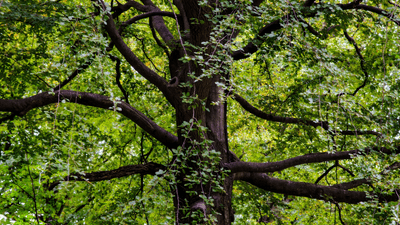


Have you ever wondered how it is that plants avoid pollinating themselves? Walnut trees have evolved to avoid this by separating their male and female flowers in time, with the flowers of one sex blooming first, and the other coming second.
Walnut trees can differ in whether they lead with female flowers or male flowers, and we’ve known about this since Charles Darwin noted it back in 1877. It’s been observed among domesticated walnut trees as well as their wild relatives, among which the ratio of female-first to male-first is about 1:1.
It wasn’t until the 1980s that we learned it all came down to a single genetic locus, as discovered by UC Davis graduate student Scott Gleeson, but we still had much to learn about how it all worked.
“Walnuts and pecans have a temporal dimorphism where they alternate male and female flowering through the season,” said Jeff Groh, graduate student in population biology at UC Davis and first author on a new paper, in a statement. “It’s been known since the 1800s but hasn’t been understood at the molecular level before.”
Groh and colleagues’ study has popped the hood on sex determination in the Juglandaceae tree family, which encompasses walnut, hickory, and pecan. With the help of Professor Graham Coop of the Department of Evolution and Ecology, they gathered data from the UC Davis walnut breeding program, as well as resident Northern California black walnut trees on campus.
They worked out which ones were female- and male-first, then sequenced their genomes to search for patterns associated with the trait. Doing so revealed that for walnuts, there are two variants of that gene Gleeson identified that can influence what sex goes first during flowering. They spotted it in at least nine species of walnut, and found that it has been a stable system for a staggeringly long time, about 40 million years.
The study also looked at pecan trees and discovered that they too have a flowering strategy that’s controlled by a distinct genetic region, but in a different area of the genome to walnut trees. For pecans it evolved around 10 million years earlier, and may be an example of convergent evolution whereby an ancient shared ancestor kicked off the trend and over time the exact genetic mechanism changed slightly.
What’s more, the system seems to work in favor of keeping that 1:1 balance between female- and male-first trees, as when one becomes more common, the other gains a mating advantage, leveling the playing field. And if that sounds familiar, that’s because it is.
“It’s pretty atypical to maintain variation over such a long time,” Groh said, and “there’s a clear parallel to a common mode of sex determination.”
The system that keeps female- and male-first walnut trees in their 50:50 balance is similar to the way animal sex chromosomes work. We humans (as well as other mammals) have two structural variants, X and Y chromosomes, that are kept roughly in balance by the way a boom in one influences the mating potential of the other.
So, the next time you’re out walking and you see a walnut tree, give it a nod. We are more alike than we realize.
The study is published in the journal Science.