


 Health and Medicine
 PUBLISHED



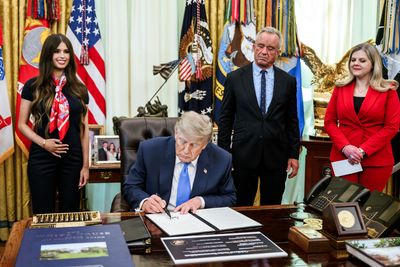


President Donald Trump has repeatedly emphasized his administration’s commitment to what he calls “gold standard science”. Experts have repeatedly emphasized that they believe his vision represents anything but.
The latest Executive Order (EO) from the White House lays out the “gold standard childhood vaccine recommendations for Americans”.
Similar to a revised childhood vaccine schedule that the Department of Health and Human Services put forth in January – only to face almost immediate legal challenge – the headline is that the EO recommends fewer vaccines for all children, and puts several under the category of “shared clinical decision-making”.
Here’s a summary of the new recommendations.
| Recommended for all children | Shared clinical decision-making |
| Measles | Hepatitis A |
| Mumps | Hepatitis B |
| Rubella | Rotavirus |
| Diphtheria | Meningococcal disease (ACWY and B) |
| Tetanus | Influenza |
| Pertussis (whooping cough) | COVID-19 |
| Polio | |
| Haemophilus influenzae type B (HiB) | |
| Pneumococcal disease | |
| Human papillomavirus (HPV) | |
| Varicella (chickenpox) |
The diseases in bold in the right column are universally recommended for “certain high-risk groups”, along with respiratory syncytial virus (RSV) and dengue vaccines.
“Shared clinical decision-making” is supposed to mean that parents of children without any underlying health concerns should make a choice about getting these vaccines for their kids in consultation with a healthcare provider.
In practice, 2025 research from the Annenberg Public Policy Center found that respondents were confused by the terminology. Two in five incorrectly believed that it meant an individual should choose whether or not to approach a medical professional for advice before deciding on a vaccine.
To summarize, an otherwise healthy child could now receive only the 11 vaccines on the left and be compliant with these recommendations. The American Academy of Pediatrics (AAP), which broke with the federal government to publish its own schedule earlier this year, recommends 18 vaccines for all kids.
From 18 to 11
For many of the vaccines no longer on the essential list, it’s not hard to make an argument for why they should be reinstated.
Events in England in March 2026 showed what can happen when a population is not adequately immunized against meningococcal disease. An outbreak of disease caused by meningococcal group B bacteria (MenB) in the city of Canterbury grew unusually quickly, leading to 21 confirmed cases and two deaths.
The outbreak centered around a university community – young adults going off to college are known to be at higher risk of meningococcal disease as they mix closely with lots of other new people.
High school students in England are routinely offered the MenACWY vaccine which protects against some strains of meningococcal bacteria, but MenB was only added to the childhood schedule in 2015. Young people currently attending university were therefore unprotected.
Catch-up vaccines are now being offered in the wake of the March outbreak.
Seasonal flu can be a serious disease for anyone, but those most at risk of complications include the very old and the very young.
The 2024-25 season saw the most US kids dying from influenza since the swine flu pandemic, and the most in a non-pandemic year since records began in 2004.
On August 10, the AAP published its policy statement on influenza control in children for the upcoming 2026 season, and it couldn’t be clearer: “The AAP recommends annual influenza vaccination of all children without medical contraindications starting at 6 months of age.”
Similarly, the AAP continues to recommend COVID-19 vaccines for all young children aged 6-23 months who, it explains, are most at risk of severe COVID.
While most adults have some degree of prior immunity from vaccines or infection, that’s not the case for children born after the peak of the pandemic.
“We’ve seen zillions of waves of COVID, but babies haven’t,” Dr Peter Chin-Hong of the University of California, San Francisco told the Los Angeles Times recently.
Antivax tropes
Going back to the EO, it includes a couple of other points that are worthy of attention.
One is the statement that “the combined measles, mumps, rubella (MMR) vaccine should be administered in three separate single-disease shots once such products are domestically available.”
This is an old argument from antivaxxers – that the combined MMR vaccine is somehow less safe than separate shots would be – and it has often been debunked by scientists.
Ultimately, there is no good evidence that splitting up the vaccines is necessary, and leaving space between vaccine doses only increases the risk that children will be exposed to disease before they’ve had a chance to be protected.
Given the current re-emergence of measles in the US, we need greater vaccine coverage, not more gaps.
In Section 3 of the EO, there’s also a reference to developing “additional alternative adjuvants to aluminum”.
Adjuvants are ingredients designed to maximize the immune response elicited by a vaccine. They’re an important component of vaccine science and research is being conducted all the time to find new and better ones, like these experimental “super-adjuvanted” cancer vaccines that we reported on last year.
Aluminum adjuvants have been used for years in several inactivated vaccines, including the Tdap (combined vaccine against tetanus, diphtheria, and pertussis). There’s no scientific reason right now to suggest that an alternative is needed for these vaccines.
A considerable body of research suggests aluminum adjuvants are safe and do not cause any long-term health issues, but this is another antivax myth that has proven extremely persistent.
During the signing of the EO, reports Joshua P. Cohen for Forbes, Trump made a range of false statements, including once again associating childhood vaccines with the development of autism.
There is no scientific basis for this claim.
He also incorrectly compared the number of vaccines received by US kids versus their counterparts in Europe, and made erroneous claims about the physical volume of vaccine contained in each shot being akin to a “bottle of soda”. In reality, most are less than a milliliter.
Perhaps most shockingly, Trump also falsely claimed that the combined MMR can be “lethal” whereas separate shots are safe.
In an Op-Ed for the University of Minnesota’s CIDRAP, Dr Jake Scott of Stanford University wrote, “That is the president of the United States telling parents, twice, on camera, that the shot their pediatrician recommends may kill their child.”
Should the recommended schedule from the EO be enacted, Scott continues, other vaccine-preventable diseases will re-emerge, and children and vulnerable adults will be hospitalized and die as a result.
“None of that is a prediction about something unknowable. It is what happened in Japan, in the United Kingdom after Andrew Wakefield sowed misinformation, and in every community where coverage has slipped since.”
“We know how this goes, because we have watched it go.”
Senator Bill Cassidy (R-Louisiana), who is an MD, expressed significant concern over the EO in a series of posts on X.
“If we’re going to Make America Healthy Again, take into account what is more likely to prevent diseases and what is convenient for the mother and the family,” he wrote.
Any official change to the federal vaccine recommendations generally require approval from the director of the Centers for Disease Control and Prevention (CDC), although a legal expert told the Associated Press that it may yet be possible for the President to circumvent this.
It remains to be seen how newly appointed CDC director Dr Erica Schwartz – a previous public supporter of childhood vaccines – will respond to the EO.




 1
1