Health and Medicine
 PUBLISHED
 1
1





Cast your mind back six years to August 2020. Humanity was eight months into one of the most tumultuous years in living memory.
On July 16, the US had reported a record 75,600 new COVID-19 infections in a single day.
Only days before that, the World Health Organization had – under increasing pressure from scientists – announced that the SARS-CoV-2 virus was being transmitted through the air and that asymptomatic individuals were likely driving its spread.
It’s hard to remember now just how little we knew about the virus back then, and how doctors across the world were scrambling to find the best ways to treat the sick amid an onslaught of patients. It would also be several months still before the first vaccines got into people's arms.
In 2020 and 2021, COVID-19 ranked as the third leading cause of death in the US. By 2024, it had dropped right down to 15th place.
With the Centers for Disease Control and Prevention (CDC) estimating that cases are once again on the rise in 43 states (as of August 5, 2026), let’s explore how we got here and how we’re still dealing with this virus today.
Anatomy of a pandemic
Not every new disease becomes a pandemic, but COVID-19 had all the right ingredients. As we now know, airborne and asymptomatic transmission allowed it to spread rapidly, and international travel sent it across the globe before science really understood what it was dealing with.
On top of that, pretty much everyone was vulnerable to infection, as there was no similar virus that had spread widely in the global population before. That also meant there were no specific treatments or vaccines.
Early superspreader events caused major outbreaks, such as the one seen in February 2020 on the Diamond Princess cruise ship.
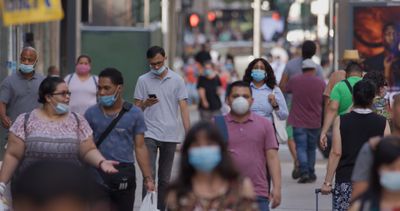
Governments had to respond. In the US and in many countries across the world, mass gatherings were banned, schools were closed, hospitality venues were shuttered, and people were sent to work from home.
These measures, research has shown since, were effective at limiting the spread of the virus, though not enough to fully get the pandemic under control – in fact, one study found that the 2-meter (or 6-feet in countries that use imperial measures) social distancing rule may not have been enough in some circumstances.
SARS-CoV-2: inside a virus
From a scientific perspective, the first priority with a new pathogen is to genetically sequence it. With SARS-CoV-2, its genome sequence was first publicly shared sometime in early January 2020, though the exact date has been in question.
With that first step completed, scientists around the world turned their attention toward different aspects of the virus’s genetics, modes of transmission, how it behaved inside the human body, and where its vulnerabilities lay.
It was a massive collaborative effort; journals that ordinarily kept their output behind subscription paywalls made COVID-related papers freely available, and global scientific communication never ceased – even if more of it had to happen over Zoom.
You can still keep up with the ever-growing body of COVID literature via resources like the National Library of Medicine’s LitCovid repository.
It wasn’t all plain sailing. With hindsight, many regret that it took so long for the WHO to officially recognize the role of airborne transmission, even when scientists were pointing to data they felt proved the case.
“[W]hen you see the spread so significantly, do you still wait for a nice Nature or Science article?” commented building environment engineer Yuguo Li to Nature News in 2022.
With that acceptance came a renewed focus on masks and ventilation as non-pharmaceutical measures. These began to take precedence over advice from earlier in the pandemic about the importance of sanitizing surfaces, as it became clear that this was a less common route of transmission.
Remember people fighting over toilet paper at the grocery store, only to go home and douse the packaging in Lysol before allowing it inside the house? What a time.
The search for antivirals
With the genome sequence in hand and basic research ongoing, scientists could begin studies looking into ways to neutralize the virus with drugs, and to develop vaccines.
The first antiviral drug to be approved to treat COVID-19 in the US was remdesivir. However, as Jon Cohen and Kai Kupferschmidt explained for Science Insider, its approval by the Food and Drug Administration (FDA) and dealings between manufacturer Gilead and the FDA and European Union were mired in considerable controversy.
Trials produced mixed results before a large study from the WHO found that the drug didn't measurably improve recovery times or mortality rates in COVID patients. That study, Cohen and Kupferschmidt point out, wasn't included in the FDA's review of the drug before approval.
The drug is still used today, though the first choice antiviral is now Pfizer’s Paxlovid, a combination treatment containing the drugs nirmatrelvir and ritonavir.
This can be administered in pill-form – much more convenient than remdesivir, which has to be given through an IV – although some people can’t use it due to interactions with other drugs.
Per infectious disease experts at Yale Medicine, the nirmatrelvir in Paxlovid inhibits an enzyme that SARS-CoV-2 needs to make functional replicates. When the enzyme is inhibited, new virus particles won't be able to enter other cells in the body, stopping the infection from progressing.
Ritonavir, meanwhile, stops the nirmatrelvir from being broken down and allows it to work for longer.
Advances in healthcare
Healthcare systems have emergency plans for pandemic scenarios. They have to try to protect the health of their workers while caring effectively for a large influx of patients.
Over time, patterns start to emerge: who is being most severely affected by the illness, what factors influence that, and what treatments seem to work better than others.
As well as prescribing antivirals like Paxlovid, which may shorten the duration of illness or decrease severity, doctors now understand much more about how to treat people who get severe COVID.
One example is proning. Patients in hospital with COVID may be encouraged to lie in a prone position – that is, on their bellies – as it can sometimes help increase blood oxygen levels when people are having difficulty breathing.
We know that because doctors experimented with this during the earlier phases of the pandemic and saw that it helped.
Another huge difference between now and early 2020 is that most everyone who contracts COVID is likely to have some prior immunity, either from a vaccine or from a previous infection.
Vaccines for COVID-19 were produced remarkably quickly, thanks to years of research that had already been done to enable scientists to quickly pivot to this new viral threat.
The early vaccine rollout included mRNA vaccines from both Moderna and Pfizer/BioNTech, which are still in use today, and the Oxford/AstraZeneca and Johnson & Johnson adenovirus vector vaccines.
Clinical trials don’t just stop when a medicine is approved. As the Oxford/AstraZeneca and Johnson & Johnson vaccines were rolled out to more people, scientists kept watch for any side effects that might have been missed in the initial trials.
It became clear that, in rare cases, these vaccines could cause a potentially life-threatening clotting condition called VITT (vaccine-induced thrombocytopenia and thrombosis). It took until February 2026 for scientists to publish findings that resolved how this happened.
Once the risk of VITT had been identified, vaccine recommendations were changed so that those people would be offered an mRNA vaccine instead.
In 2024, AstraZeneca pulled its COVID vaccine from the market. Overall, it wasn’t unsafem, and it did play a major role in getting us out of the worst of the pandemic. But it had not been updated to match newer virus variants and was less in-demand given that people had easy access to more up-to-date mRNA vaccines.
Same virus, different threat
All of this means that if you come down with COVID-19 today, any doctor treating you has six years of accumulated knowledge and a suite of treatment options to draw on. You may also have chosen to be vaccinated and receive regular boosters, all of which will affect your risk of severe disease.
And also, the SARS-CoV-2 of today is different from the one that first started spreading in 2019. The virus has mutated and evolved through several generations of variants, and the disease it causes has become less severe.
The variants circulating today are branches of the Omicron lineage. First emerging in late 2021, research in April 2022 suggested that people infected with Omicron were three times less likely to be hospitalized than those infected with the earlier Delta variant.
But there is a caveat, as Dr Peter Chin-Hong of the University of California, San Francisco, told the Los Angeles Times recently: “We’ve seen zillions of waves of COVID, but babies haven’t.”
Children born after 2020 don’t have the benefit of prior immunity from vaccines or infection. Chin-Hong recommends everyone, including children aged 6 months and up, get an annual vaccine.
The CDC used to recommend that universally too. Today, the wording it uses is subtly different: “CDC recommends a 2025-2026 COVID-19 vaccine for people ages 6 months and older based on individual-based decision-making.”
Late last year, the FDA was criticized by a group of former commissioners following the leaking of a memo in which it was claimed that “at least 10 children” had died as a result of getting a COVID vaccine.
The former commissioners argued this claim was unsubstantiated, a politically motivated attempt to alter vaccine policy in a way that would leave children vulnerable to the acute and chronic effects of COVID – kids get long COVID too.
For many, catching COVID in 2026 is a scenario far removed from catching it in 2020, largely because of the scientific progress and other lessons we've learned along the way.
This virus is still with us, though, and future pandemics will come too. We may not be able to meet these challenges as effectively if that progress is undone and those lessons unlearned.