Health and Medicine
 PUBLISHED






The MAHA movement has a new target in its crosshairs. You can’t smell it, you can’t see it… and most importantly of all, there’s no scientific consensus that it causes health issues.
Robert F. Kennedy, Jr., US Health and Human Services (HHS) Secretary, recently announced the Trump administration is launching a formal Request for Information around radiofrequency (RF) emissions and electromagnetic radiation.
In a post on X, Kennedy said the investigation would “identify gaps in our knowledge and make sure that federal policy keeps pace with rapidly changing technology.” Members of the public, scientists, and really anyone with a view on this issue are invited to respond to the inquiry.
Not all radiation is created equal
“Radiation” sounds scary, of course it does, and there are definitely forms of radiation humans should stay away from as much as we possibly can.
Gamma rays are the clearest example. These are a form of ionizing radiation that can damage body tissues and cause genetic mutations, so even small doses can be deadly. Even X-rays, despite their obvious usefulness in medicine, pose risks that mean we must limit people's exposure to them.
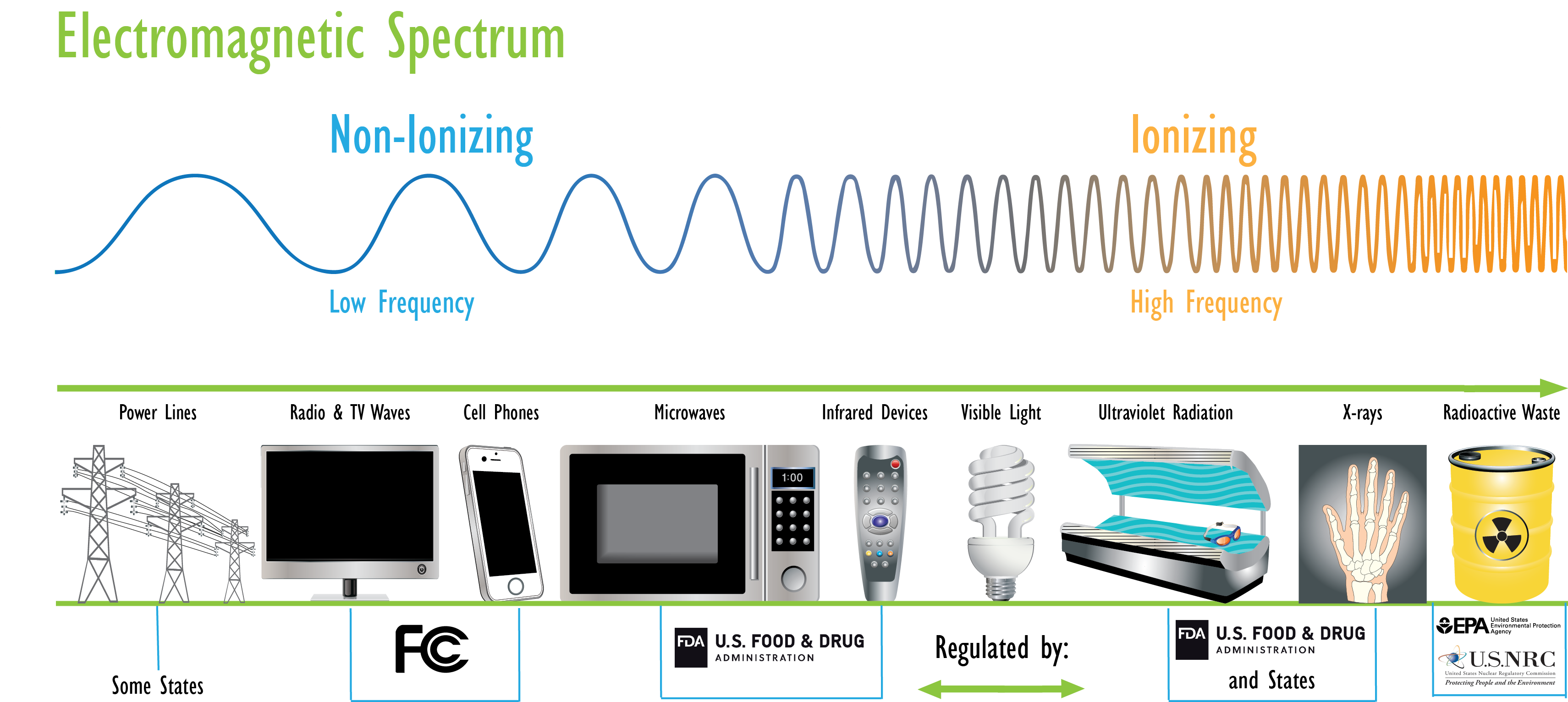
Radio frequencies, on the other hand, are non-ionizing and approximately a billion times less powerful, so they can't cause tissue or DNA damage in the same way. That’s a good thing, because we’re exposed to RF emissions all the time.
The RF Safety Program at the Federal Communications Commission (FCC) explains that the most common application of RF energy is in telecommunications. That includes everything from radios and TVs to cellphones and satellite phones, so US citizens have been exposed to this kind of radiation routinely for almost a century at this point.
Microwave ovens are another example that you likely have in your house, and while that might seem like a more dangerous form of radiation, you'd really have to get inside one for it to cause you any harm. There are also medical applications for microwave radiation, such as in MRI machines.
Settled science or an open question?
Right now, the bottom line is that there’s no clear scientific evidence that RF emissions cause cancer or are otherwise a threat to human health. In fact, a statement to this effect still exists on the FDA website if you look hard enough. But absence of evidence doesn't necessarily mean evidence of absence, so is it something we should be investigating more seriously?
Maybe it's a fair question to ask. We have, after all, gone from households with just a couple of TV sets and a radio to being totally surrounded by wireless devices in just a few short decades. There are also many anecdotal reports – from those living in close proximity to mobile phone base stations, for example – of people believing their health has been impacted.
Beyond anecdotal evidence, there have even been some studies that purport links between RFs and negative health effects, but these have generally been in animals and so aren't directly applicable to humans. Studies in humans often face their own limitations, including that they tend to rely on people's reported phone use, which isn't always reliable.
So, while a large-scale World Health Organization assessment of the evidence in 2024 underscored that the field would benefit from more high-quality evidence, it ultimately concluded the following:
“Exposure to RF from mobile phone use likely does not increase the risk of brain cancer. RF from broadcasting antennas or base stations likely does not increase the risk of childhood cancer. Occupational exposure to RF may not increase the risk of brain cancer.”
A separate 2021 review found claims of a link between RF exposure and cancer in humans are “not supported by the current evidence base,” though it too suggested there was a need for higher-quality studies.
Speaking with Scientific American earlier this week, Kenneth Foster, an emeritus professor of bioengineering at the University of Pennsylvania, said there had been a lack of red flags in studies so far, suggesting the effects of radio frequency radiation are either nonexistent or tiny compared with other health stressors people might be exposed to in their daily lives.
Gayle Woloschak, a professor at Northwestern University, told the New York Times earlier this year: “There’s no risk of anything hazardous or dangerous with radiation from cellphones.”
It’s not clear that the new investigation from HHS will add anything of value beyond what scientific studies – of which the above are just some examples – have shown, as it can be expected to draw a lot of anecdotes and probably not much in the way of rigorous analysis that would really be needed to fulfill the demand for higher-quality research called for by these previous reviews.
What RFK Jr says about RF radiation
It isn't the first time Kennedy has turned his attention towards the topic of radio frequency emissions, which have been a long-term bugbear of his. In praising cellphone restrictions in US high schools, he cited the supposed risk of cancer from cellphone use. In January 2026, the Wall Street Journal reported that Food and Drug Administration webpages stating that cellphones aren’t dangerous were quietly removed.
According to Kennedy’s recent announcement, HHS is now giving the issue the “gold-standard science” treatment that has been a mainstay of Trump administration policy.
This idea is itself controversial, with the group Stand Up For Science writing in an open letter in response to the "gold-standard" executive order: “We see through this bad faith appropriation of scientific language and principles.” Scientists elsewhere have also been less than complimentary towards the administration’s priorities when it comes to funding research.
RF energy and electromagnetic fields (EMFs) more broadly tend to crop up in lists alongside things like genetically modified organisms, “chemtrails,” and vaccine ingredients – incidentally, these latter two also featured in a recent presentation Kennedy gave to an antivax organization he founded, which the New York Times reports was “riddled with misinformation.”
In the case of RF emissions and EMFs, it may be yet another case of positioning what is, in reality, a relatively settled scientific question as an open debate.
“I don’t sense there is any great sense of panic in the government to solve this problem, because they have already invested a lot of money, and nothing has really shown up,” Foster told Scientific American.



 1
1