Health and Medicine
 PUBLISHED
 1
1




In 1895, Wilhelm Roentgen, then a professor of physics at the University of Würzburg in Germany, was testing whether cathode rays could pass through glass, when he made a discovery that was of profound importance to medicine, physics, and, eventually, security at airports.
On November 8, 1895, Roentgen was experimenting with cathode ray tubes, studying how they emit light. As he did so, he noticed that a screen on the other side of the room was glowing fluorescent – too far, he thought, for it to be coming from the rays emitted by the cathode ray tube.
As well as this, the glow continued when the cathode ray tube was covered entirely in black paper, blocking any light that we were aware of at the time.
Investigating the issue, Roentgen found that the rays were indeed coming from the cathode ray tube, and could happily pass through solid objects like wood, aluminum, and copper and hit the screen behind it.
Moreover, and more usefully, the light would pass through most objects, but leave a shadow of some solid objects (like bone).
Roentgen quickly abandoned his other research, focusing on disseminating his discovery to the world.
"Röntgen reported the discovery of X-rays in December 1895 after seven weeks of assiduous work during which he had studied the properties of this new type of radiation able to go through screens of notable thickness," a paper on the topic explained.
"He named them X-rays to underline the fact that their nature was unknown."
The discovery was immediately recognized as being extremely useful by scientists around the world, who began their work like they hadn't heard the "their nature is unknown" part.
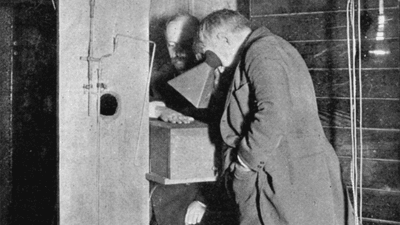
One of these scientists was Thomas Edison, famed non-inventor of the lightbulb. Whilst this would lead to the development of a useful and powerful commercial fluoroscopic device by Edison, it was not great news for his assistant Clarence Madison Dally, who lost his life due to the work he undertook with Edison.
Dally was not a scientist, but a glassblower who began working at the Edison Lamp Works after a six-year stint in the US Navy. Following this, he moved to the Edison Laboratory, where he assisted Edison with his work on incandescent lamps.
When X-rays were discovered and Edison began his work on them, he turned to Dally for his help.
This was a new type of light, and there were reasons to suspect that we should take care when experimenting with it. It wasn't long before the negative effects of X-rays were reported.
"As early as March 14, 1896, the Italian physicist Angelo Battelli called attention to the possible ill effects of roentgen rays on living tissue. He followed this communication later in the same year with a detailed study of deleterious effects of the rays on the human eye," a paper on Dally explains.
"Thomas Edison later observed some annoying symptoms of his own-which he attributed to eye strain-while working on glass tube forms for X-rays, and a Boston dentist, William Rollins, recommended covering fluoroscopic screens with some filtration 'to protect the eyes from x-light'."
Engineers raised alarm over potential harms of X-rays too, but in the fervor to study them this largely went ignored by many scientists.
Dally's role in Edison's experiments was in producing these cathode ray tubes, whilst looking for a "fluorescent lamp" which would hopefully replace lightbulbs. Unfortunately, Dally had a very simple method for testing that they were working correctly; placing his left hand directly in the beam's path.
While any radiographers out there just let out an audible yelp, we should note that this was not entirely out of the usual, with early medical adopters of the power of X-rays often calibrating their equipment by placing their own appendages in the path of their own beams.
Edison noted that Dally's hand did appear to be burned, whilst hair loss and ulceration soon followed, causing the inventor to abandon the project. But his work on X-rays continued, with Edison now focusing on using calcium tungstate as a way of detecting X-rays, making resulting X-ray images easier to see and decipher.
Dally worked on this project, and with his left hand burned, he began to place his right hand into the beam instead. Dally was not well, and began to sleep at night whilst placing both of his hands in water in an attempt to alleviate the pain, but generally assumed that given enough of a break from this work then his body would heal again.
It is worth stressing again that this work, and the study of X-rays in general, was of some importance.
In 1901, for example, Dally was asked to go to Buffalo, New York, as a matter of urgency. After President William McKinley was shot, it was hoped that one of Edison's X-ray machines, being displayed in the city at the time, could be used to identify the bullet, and Dally was called upon to install and operate the machine.
Unfortunately, the president was thought not to be stable enough to be X-rayed, and he died shortly afterwards.
Dally did not follow too far behind. Several skin grafts on Dally's damaged skin were attempted, but none of them took. Soon, Dally allowed his left arm to be amputated just below the shoulder, and after similar problems got worse on his right hand, several of his fingers were amputated too.
Dally, unable to work, was kept on the payroll by Edison for as long as he lived. That wasn't too long in the end, with Dally dying from radiation dermatitis and its complications in 1904, likely the first human fatality as the result of exposure to X-rays.
For what it was worth, this was Edison's last foray into playing around with X-rays.
“I stopped experimenting with them two years ago, when I came near to losing my eyesight, and Dally, my assistant, practically lost the use of both of his arms,” Edison later told the New York World, per Smithsonian Magazine. “I am afraid of radium and polonium too, and I don’t want to monkey with them.”