Culture and Society
 PUBLISHED
 1
1




John Van Nostrand Dorr was already a household name when he changed the world. A protégé since he was just 16 of one Thomas Edison, and founder and namesake of the Dorr Foundation for almost a decade, Dorr’s name was a mainstay of chemical engineering journals and patent offices the world over.
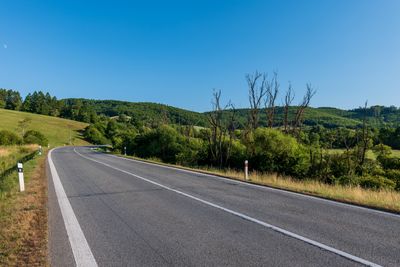
But it was nothing so academic or technical that truly secured his legacy. Rather, it was a simple white line, painted on the outermost edges of roads and highways – one that, to date, has likely saved millions of lives.
And you’ve probably never even really noticed it.
Before the idea
Born in 1872, John Dorr had been interested in geology and metallurgy ever since he was a little kid. He had something of a rough-and-tumble education: taught by his mother, a schoolteacher, he spent his formative years hiking through New Jersey to explore his home state’s numerous iron and copper mines, sleeping under haystacks and collecting any “specimens” that caught his eye.
By the time he was 16 or 17, he was working at Edison’s West Orange laboratory. His job title: “pioneer”.
“As a teenage lab assistant, Dorr learned a lesson from the master himself,” wrote The Wall Street Journal’s Ben Cohen last week. “Try anything once.”
From West Orange, he went on to Rutgers University, where he studied chemistry. It served him well: after graduating, he moved out West to Colorado and South Dakota, working with cyanide to extract gold from lower-grade ores. He pioneered the techniques of thickening, agitating, and continuous counter current decantation; by 1916, he was heading up his own eponymous company to produce and market his ever-increasing number of inventions.
“His inventions were applied also to sewage treatment, purifying waters around many large cities,” reported the New York Times in his 1962 obituary. “They have been used to de-silt the Colorado River to develop the Imperial Valley, to increase extraction of sugar from cane and beets and to produce synthetic fertilizers, among other operations.”
By 1950, he was basically a chemical superstar: holder of half a dozen honorary degrees; Chairman of the National Advisory Council to the House Committee on Patents; “the contribution which his inventions […] have made to mankind,” declared Chemical Engineering Magazine in 1949, “are probably greater than those of any other chemical or metallurgical engineer of our times.”
It was all undeniably impressive. And none of it was what birthed Dorr’s personal quest to see every road in the USA outlined by a shiny pair of white stripes.
Squinting at the light
For all that Dorr was a metallurgical genius, it was his wife who really gets the credit for his most far-reaching legacy.
“Mr Dorr set up the Dorr Foundation in 1950 to make grants in chemistry and metallurgy,” reported the New York Times. “But […] because his wife complained that headlight glare from approaching cars tended to force drivers off the road, he broadened the purpose to promote highway safety.”
The theory was this: with no lines at the edge of the road, drivers naturally tended to hug the center. That wasn’t a problem per se, until another car came along in the opposite direction – at which point you’d have to swerve towards the shoulder to avoid them. But this was the ‘50s, and the outside of roads weren’t always as well-defined as they are today: drive too far to the right, and you might end up totaled in a ditch.
Things got much worse at night. Then, not only was visibility worse, but any traffic in the other lane would come at you with near-blinding headlights. No way could drivers focus on the center line while facing down such a bright light – and as a result, crashes were frequent, and motor vehicle deaths were about twice the rate they are today.
Dorr thought that could be changed with the simple addition of another white line – one on the outside of the lane. That may sound like an obvious addition today, if only because those lines are, you know, everywhere, but you’d be surprised at how much resistance Dorr faced: “When I first suggested it” to the Connecticut highway commissioner, he later wrote, “it was turned down completely.”
There was only one way forward: he had to go to the media.
A dandy suggestion
Undeterred by the official pushback, Dorr instead wrote to the Westport Town Crier newspaper. Oncoming headlights were “particularly blinding on a rainy or snowy night,” he argued; an outside edge line would be so helpful that he “would gladly pay for a demonstration test of a few miles.”
How could any Westportian refuse? “Dr. Dorr’s suggestion,” the paper declared, “is a dandy.”
So began a somewhat rough-and-ready science experiment: for a few miles between Greenwich and Stamford, outside lines were added to the road, and the effects monitored.
They couldn’t have been more positive for Dorr: “The position and driving behavior of 11,289 vehicles along this test strip demonstrated that the shoulder lines improved automobile position in the center of the lane,” wrote public policy researcher Steven Schindler in the 2007 Casebook for The Foundation: A Great American Secret. They “corrected speed differentials resulting from adverse driving conditions, and nullified the effects of distracting roadside features, particularly during the dawn and dusk hours.”
“These results supported the conclusions that shoulder striping would reduce same direction sideswipe accidents, would prevent the early destruction of paved shoulders, and would prevent accidents resulting from automobiles losing traction upon drifting onto the soft shoulders.”
With such encouraging results, the idea spread – but not far. New York hesitatingly rolled out a six-month trial on a stretch of road in Westchester popularly known as “Death Valley” because of the high rate of accidents there.
“In seven months prior to the application of white stripes along the parkway shoulders, 102 accidents resulting in forty-nine injuries occurred,” Stevens reported. “In the seven months after the application of the white stripes in 1954, only forty-six accidents occurred with twenty-seven injuries, a 55 percent reduction from the pre-stripe period.”
Vindication at last
Perhaps you would think all this was a slam-dunk for Dorr and his pet project. Instead, highway officials came up with ever-more inventive reasons to reject his idea: some said the lines were too expensive to paint; others that their lifesaving effect was overstated; in California, it was even argued that adding edge lines would confuse drivers so much that they’d end up driving off the road entirely, thinking they were following the center line rather than the outside one.
Time and again, though, Dorr’s edge lines proved their worth. In Ohio, where the state highway director informed Dorr that “we have not found any locations where we believe edge-marking would yield sufficient value to warrant its extensive use,” a controlled, randomized experiment found that lined highways cut fatalities and injuries by more than a third.
What’s more, the public loved the lines. Newspapers championed them: “it has been popularly acclaimed by many motorists,” reported The New York Times in 1957, “who have found the line delineating the safe edge of the road a particular help.” Letters to the editor praised the lines, and sometimes Dorr specifically; it seemed that once road users were given the lines, they really didn’t want to give them up.
It was only a matter of time before highway officials gave in. “The Public is demanding it,” the chief of research of the Bureau of Public Roads wrote in a 1958 report to the Highway Research Board, according to the Wall Street Journal. “Everywhere drivers are saying: ‘This is the finest thing we’ve ever seen.’”
“As highway engineers,” he advised, “we’ve got to stop dragging our feet.”
And so they did. Less than a decade after he began his crusade, Dorr’s white lines were virtually universal across the US, painting his legacy across the very country itself.
His name may not be famous; his inventions may not be popular outside of a niche section of engineering – but John Dorr changed the everyday world more profoundly than most others, and saved countless lives in the process.